
Decoding Pet Food Labels: Nutrients, Ingredients, and What the Fine Print Really Means

| Moisture listed on dry kibble | Typically 10% or less (AAFCO model regulations) |
| Moisture listed on wet/canned food | Often 75% to 82% (AAFCO model regulations) |
| Minimum guaranteed analysis nutrients | Crude protein and crude fat (AAFCO label requirements) |
| Maximum guaranteed analysis nutrients | Crude fiber and moisture (AAFCO label requirements) |
| Life stages covered by AAFCO profiles | Growth, adult maintenance, reproduction, all life stages (AAFCO Official Publication) |
How pet food labels are structured
Every bag, can, or pouch of commercial pet food sold in the US must display a specific set of label elements, governed largely by the Association of American Feed Control Officials (AAFCO) and state feed laws. Knowing where each piece of information lives on the package is the first step to reading it well.
The required elements are: the product name, a net weight or volume statement, the manufacturer name and contact address, a list of ingredients, a guaranteed analysis panel, a nutritional adequacy statement, and feeding directions. Some packages also carry optional marketing copy on the front, which has no regulatory definition and can be freely worded by the manufacturer.
The front of the pack is advertising. The back or side panel is where the regulated content appears. When you want facts rather than impressions, flip the bag over.
AAFCO
The Association of American Feed Control Officials. A voluntary membership organization that establishes model regulations and nutrient profiles used by US states to govern the labeling and sale of animal feed and pet food.
Guaranteed analysis
A panel on pet food labels that states minimum crude protein and fat percentages, and maximum crude fiber and moisture percentages. These are legal thresholds, not exact nutrient measurements.
Dry matter basis
A method of comparing nutrient levels across foods with different moisture contents by calculating what the nutrient percentage would be if all water were removed from the food.
Nutritional adequacy statement
A required label statement indicating whether a food is complete and balanced for a specific life stage, and whether that claim is based on AAFCO nutrient profiles or actual feeding trials.
Ingredient splitting
The practice of listing multiple forms of the same ingredient separately on a label, which distributes each form lower in the ingredient order than a combined listing would produce.
Meal (ingredient)
A rendered, moisture-reduced protein ingredient such as chicken meal or fish meal. Because water has been removed, meals are more concentrated by weight than fresh or raw equivalents listed on the same label.
Reading the ingredient list
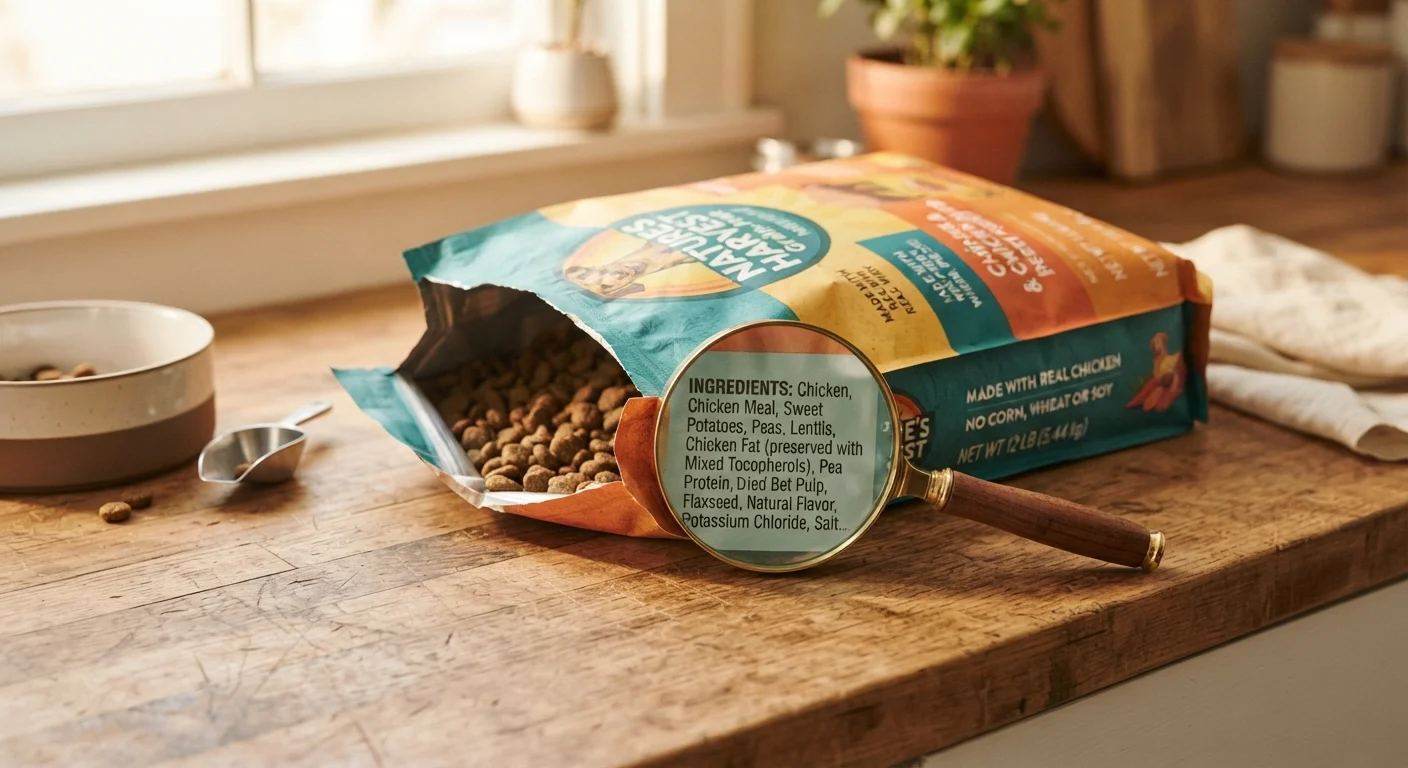
Ingredients are listed in descending order by pre-cooked weight. A meat listed first sounds reassuring, but raw meat contains a high proportion of water. After cooking, its weight can drop significantly, meaning a grain or meal listed lower may actually contribute more protein by dry weight than the top-listed meat ingredient.
"Meal" ingredients (such as chicken meal or salmon meal) are rendered products with most moisture already removed. They are more concentrated by weight than their fresh counterparts and are not inherently inferior. The quality of any meal depends on the source material and manufacturing process, which a label alone cannot fully confirm.
Ingredient splitting is worth knowing about. A manufacturer can list multiple forms of the same ingredient separately, for example "ground corn," "corn gluten meal," and "corn bran," which pushes each entry lower on the list individually even though corn is present in substantial combined quantity.
For more on how protein sources vary in nutritional completeness, see complete vs. incomplete protein sources.
Decoding the guaranteed analysis panel
The guaranteed analysis lists minimum percentages for crude protein and crude fat, and maximum percentages for crude fiber and moisture. The word "crude" refers to the measurement method, not the quality of the nutrient. These are legal minimums and maximums, not precise nutritional targets, and actual nutrient levels in a given batch may be higher or lower within those bounds.
| Moisture listed on dry kibble | Typically 10% or less (AAFCO model regulations) |
| Moisture listed on wet/canned food | Often 75% to 82% (AAFCO model regulations) |
| Minimum guaranteed analysis nutrients | Crude protein and crude fat (AAFCO label requirements) |
| Maximum guaranteed analysis nutrients | Crude fiber and moisture (AAFCO label requirements) |
| Life stages covered by AAFCO profiles | Growth, adult maintenance, reproduction, all life stages (AAFCO Official Publication) |
Comparing guaranteed analysis numbers across different products requires one adjustment: foods with different moisture levels are not directly comparable as printed. A wet food showing 8% protein and a dry food showing 28% protein cannot be compared until both are converted to a dry matter basis. To do this, divide the nutrient percentage by (100 minus the moisture percentage), then multiply by 100. A wet food with 8% protein and 78% moisture works out to roughly 36% protein on a dry matter basis, which is actually higher than many dry kibbles.
Since feeding guides on packaging are averages rather than prescriptions, see why the feeding guide is just a starting point for more context on how to adjust for your individual pet.
Nutritional adequacy statements and life stage claims
The nutritional adequacy statement is one of the most practically useful parts of the label. It tells you whether the food is formulated to meet AAFCO nutrient profiles, or whether it was validated through feeding trials. It also specifies the life stage the food is intended for: adult maintenance, growth (puppies or kittens), reproduction, or all life stages.
"All life stages" means the food meets the higher nutrient requirements of growth and reproduction, so it is suitable for puppies and kittens as well as adults. Adult maintenance formulas are calibrated to lower requirements and may not supply adequate calcium, phosphorus, or energy density for growing animals.
A product labeled "for intermittent or supplemental feeding only" does not meet complete and balanced standards and should not be used as a sole diet. This phrase appears on treats, meal toppers, and some specialty foods.
Front-of-pack claims like "natural," "holistic," or "premium" carry no AAFCO definition and impose no nutritional standard. For a broader look at how marketing language on food packaging can mislead, the article food labels that can mislead even careful shoppers covers this pattern in detail.
If you are managing a pet's weight alongside understanding their diet, weight management in pets explains the broader picture beyond what a scale shows.
This article provides general educational information about pet food labeling and is not a substitute for advice from a licensed veterinarian. If your pet has specific health conditions or dietary needs, consult your vet before making changes to their diet.