

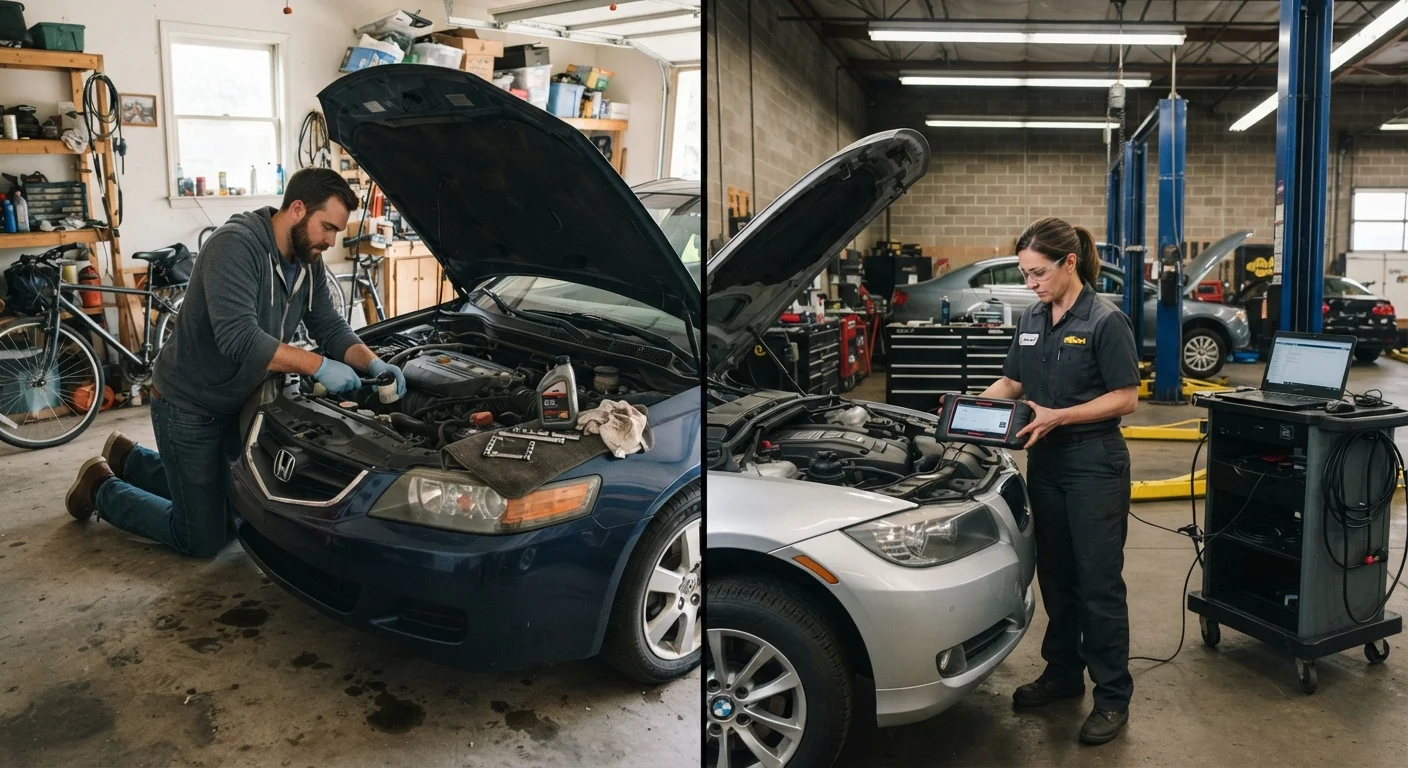
Key Takeaways
- DIY maintenance can cut routine service costs significantly, but requires the right tools and mechanical confidence.
- Professional workshops offer diagnostics, specialized equipment, and liability coverage that home garages cannot match.
- Tasks like oil changes and air filter swaps are manageable for most drivers; brake systems and transmission work are not.
- Improper DIY repairs can void manufacturer warranties or create safety hazards more costly than the original job.
- The smartest approach for most drivers combines DIY on simple jobs with workshop visits for complex or safety-critical work.
Lower cost on routine, repeatable maintenance tasks
Materials for a DIY oil change or air filter swap typically cost 40 to 60 percent less than the same service at an independent shop, and the savings repeat every service interval.
Full control over parts and fluid specifications
A DIY mechanic chooses exactly which oil grade, filter brand, or spark plug type goes into the vehicle, with no uncertainty about substitutions.
Builds mechanical familiarity with your own vehicle
Regular hands-on contact with the engine bay and undercarriage makes it easier to notice changes in condition, sounds, or leaks between services.
Flexible scheduling with no shop wait times
Home maintenance happens on the owner's timeline, without booking windows, drop-off logistics, or waiting for a service advisor.
Satisfying for mechanically inclined drivers
Many drivers report that completing their own maintenance builds confidence and a stronger sense of ownership over the vehicle's condition.
Upfront tool investment can erase early savings
A basic set of quality tools, including a floor jack, jack stands, torque wrench, and filter wrench, can cost $200 or more before a single job is done.
Mistakes can cause damage more costly than the original job
Overtightened fasteners, wrong fluid specifications, or improperly seated components have caused failures that turn a $50 task into a several-hundred-dollar repair.
No access to professional-grade diagnostic equipment
Consumer OBD-II scanners read generic fault codes but cannot access manufacturer-specific data streams that a professional scan tool uses to diagnose complex electrical or drivetrain issues.
DIY errors on safety systems carry serious consequences
Incorrect brake, suspension, or steering work directly affects vehicle control, and liability for any resulting accident rests with the person who performed the repair.
Record-keeping gaps can complicate warranty claims
Without receipts and dated service logs, a manufacturer or dealer may dispute whether correct materials were used during a DIY service, complicating a warranty claim.
Our Verdict
DIY car maintenance makes sense for drivers who are comfortable with basic mechanical tasks, have the necessary tools, and are working on routine, low-risk jobs. A professional workshop is the right call for anything involving safety systems, advanced diagnostics, or work covered by a warranty. Most everyday drivers will spend less overall and keep their vehicles safer by handling straightforward upkeep themselves while leaving complex repairs to a qualified technician.
DIY suits mechanically confident drivers maintaining routine systems; a workshop suits anyone dealing with safety-critical repairs, unfamiliar symptoms, or vehicles still under warranty.
What counts as DIY-friendly maintenance
Not all maintenance tasks carry the same level of complexity or risk. Several jobs fall well within reach of a driver who can follow a repair manual, owns basic hand tools, and has a few hours on a weekend. These include oil and filter changes, air filter replacement, cabin filter swaps, wiper blade installation, battery replacement, and topping up washer fluid or coolant.
These jobs share a common trait: they involve accessible components, require no specialized diagnostic equipment, and carry limited consequences if a step is missed and quickly caught. A driver who completes their own oil change on schedule is doing exactly what a service interval requires, with full control over the oil grade and filter quality used.
For a broader picture of what routine upkeep involves across a vehicle's life, the complete guide to keeping your car in peak condition covers service milestones and fluid checks in practical detail.
Where professional workshops have a clear advantage
Certain jobs demand equipment, training, or liability coverage that no home garage can replicate. Brake system overhauls, wheel alignment, transmission service, suspension work, and any repair tied to onboard electronics fall into this category. Modern vehicles rely on controller area network (CAN) bus systems and manufacturer-specific software to diagnose fault codes accurately. A generic OBD-II scanner reads basic fault codes but cannot access the deeper diagnostic layers that a workshop's dealer-level or professional scan tool reaches.
Wheel alignment is one job that drivers sometimes underestimate. Incorrect alignment accelerates tire wear and affects handling in ways that are not always immediately obvious. The difference between wheel alignment and wheel balancing is worth understanding before deciding whether either service belongs in a home driveway. The answer for both is almost always no.
Warranty protection and DIY service
Under the Magnuson-Moss Warranty Act, vehicle manufacturers cannot void a warranty solely because an owner performed their own maintenance, provided the correct parts and fluids were used and records were kept. However, if a DIY repair is directly connected to a later component failure, the related warranty claim may still be denied. Keeping dated receipts and a written service log is the most reliable way to protect your position.
Workshops also carry insurance coverage for work they perform. If a DIY brake job fails and causes an accident, the liability rests with the person who did the work, not a licensed shop.
The real cost comparison
$100+
Typical shop markup on common service parts
Industry surveys of independent repair shops indicate parts markups of 25 to 100 percent above retail price are common, which widens the DIY savings gap on parts-heavy jobs.
40-60%
Potential material cost savings on DIY oil changes
Comparing retail oil and filter costs against typical independent shop service prices suggests material savings in this range for standard four-cylinder vehicles.
$200+
Minimum starter tool investment for basic DIY
A floor jack, jack stands, drain pan, torque wrench, and filter wrench represent a realistic minimum outlay before a first DIY service can be safely completed.
The upfront savings from DIY maintenance are real but not unconditional. A DIY oil change on a common four-cylinder sedan typically costs between $30 and $60 in materials, compared to $75 to $120 at many independent shops. Over several years, those savings add up. However, they depend on already owning the right tools. A floor jack, jack stands, drain pan, filter wrench, and torque wrench together can cost $200 or more at the outset.
Mistakes carry their own costs. Stripping an oil drain plug, overtightening a spark plug, or cross-threading a lug nut can turn a $40 job into a $300 repair. Workshop technicians work under quality-control processes that reduce those errors, and reputable shops will correct their own mistakes at no charge.
Fluid maintenance is one area where DIY research pays dividends regardless of who does the work. Understanding what transmission fluid and engine oil each do helps any driver verify that a shop is using the correct specification, whether or not they handle the service themselves.
Warranty and safety considerations
Vehicles under a manufacturer's warranty or an extended service contract can be serviced at home, but the owner must keep detailed records: receipts for parts, dates of service, and mileage at the time of each job. The Magnuson-Moss Warranty Act protects consumers in this area: a manufacturer cannot void a warranty simply because an owner performed their own oil change, provided the correct materials were used. However, if a DIY repair is directly linked to a subsequent failure, the warranty claim for that failure may be denied.
Safety-critical systems are the clearest line in this decision. Brake pads, rotors, calipers, wheel bearings, steering components, and tire mounting all have direct consequences for vehicle control. The National Highway Traffic Safety Administration (NHTSA) attributes a meaningful share of crash causes to vehicle component failure. A professional technician who inspects these systems routinely will catch wear that a visual check from the driveway may miss.
Seasonal maintenance adds another layer of complexity that often benefits from professional input. The seasonal car maintenance checklist outlines what to verify before winter and summer conditions, some of which, such as coolant concentration testing or battery load testing, require instruments most home mechanics do not own.
Building a practical hybrid approach
Lower cost on routine, repeatable maintenance tasks
Materials for a DIY oil change or air filter swap typically cost 40 to 60 percent less than the same service at an independent shop, and the savings repeat every service interval.
Full control over parts and fluid specifications
A DIY mechanic chooses exactly which oil grade, filter brand, or spark plug type goes into the vehicle, with no uncertainty about substitutions.
Builds mechanical familiarity with your own vehicle
Regular hands-on contact with the engine bay and undercarriage makes it easier to notice changes in condition, sounds, or leaks between services.
Flexible scheduling with no shop wait times
Home maintenance happens on the owner's timeline, without booking windows, drop-off logistics, or waiting for a service advisor.
Satisfying for mechanically inclined drivers
Many drivers report that completing their own maintenance builds confidence and a stronger sense of ownership over the vehicle's condition.
Upfront tool investment can erase early savings
A basic set of quality tools, including a floor jack, jack stands, torque wrench, and filter wrench, can cost $200 or more before a single job is done.
Mistakes can cause damage more costly than the original job
Overtightened fasteners, wrong fluid specifications, or improperly seated components have caused failures that turn a $50 task into a several-hundred-dollar repair.
No access to professional-grade diagnostic equipment
Consumer OBD-II scanners read generic fault codes but cannot access manufacturer-specific data streams that a professional scan tool uses to diagnose complex electrical or drivetrain issues.
DIY errors on safety systems carry serious consequences
Incorrect brake, suspension, or steering work directly affects vehicle control, and liability for any resulting accident rests with the person who performed the repair.
Record-keeping gaps can complicate warranty claims
Without receipts and dated service logs, a manufacturer or dealer may dispute whether correct materials were used during a DIY service, complicating a warranty claim.
Most drivers do best with a clear mental split: DIY for consumables and simple bolt-on parts, workshop for anything structural, electronic, or safety-related. Keeping a vehicle log that records every service, whether performed at home or at a shop, builds a maintenance history that protects resale value and simplifies warranty conversations.
Before any long drive, running a structured inspection covers both DIY-checkable items and issues that warrant a professional look. The pre-long-trip vehicle check provides a walkthrough that works for both approaches. High-mileage vehicles shift the balance further toward professional involvement, since worn seals, aging hoses, and deteriorating components are harder to assess without hands-on experience. The maintenance priorities for high-mileage vehicles details which systems deserve closer attention as odometer numbers climb.