

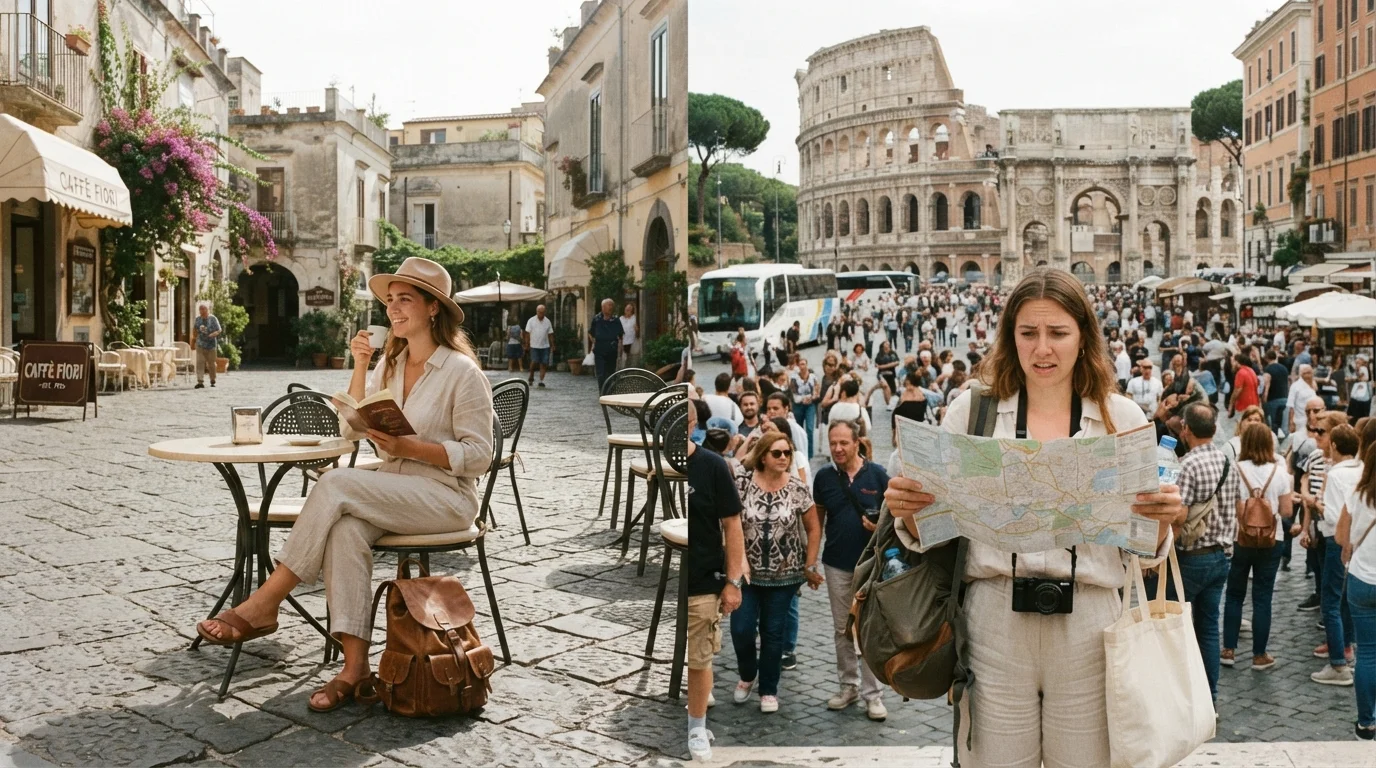
Key Takeaways
- Slow travel reduces transit stress and often lowers daily costs, but limits how many destinations you see.
- Packed itineraries let you cover more ground but increase the risk of exhaustion and missed depth.
- Your trip length, travel goals, and physical stamina should drive which approach you choose.
- Hybrid planning, fewer destinations with select day trips, can balance both styles for many travelers.
Lower daily costs through longer-stay rates
Weekly accommodation rates frequently run 20 to 40 percent below nightly prices, and having a kitchen cuts food spending. Transit costs between cities disappear entirely when you stay put.
Less physical and mental exhaustion
Constant repacking, reorientation, and navigating new transit systems adds cumulative fatigue. Staying in one place removes that overhead and leaves more energy for the actual experience.
Deeper familiarity with a single place
Learning a neighborhood's rhythms, finding reliable local spots, and building even casual familiarity with residents produces a qualitatively different trip than a quick pass through.
More flexibility when plans change
With no fixed transit between multiple cities, a sick day or a weather delay does not cascade into missed bookings. You simply adjust the day's plan without financial penalty.
Fewer destinations covered in the same window
If your goal is to see multiple distinct regions or countries, slow travel in one place means others stay on the list. This is a real trade-off, not just a perception issue.
Requires more advance accommodation planning
Securing a weekly or monthly rental in a popular destination typically requires booking further ahead than a single hotel night. Last-minute slow travel is harder to arrange.
Slower pace can feel restless for some travelers
Travelers who recharge from novelty and activity may find slow travel underwhelming, especially in the first few days before a routine sets in.
Depth is lost on short trips
Slow travel rarely reaches its rhythm in fewer than four or five days. On a six-day trip, the approach can leave a traveler feeling under-explored rather than immersed.
Our Verdict
Neither approach is objectively better. Slow travel suits people who want to absorb a place rather than document it, and it tends to reward travelers who have the flexibility to stay longer. Packed itineraries work when you have a finite destination list and enough energy to sustain a fast pace without burning out. Most travelers land somewhere in the middle, and intentional planning in either direction produces better trips than defaulting to habit.
Slow travel is best for travelers with at least one to two weeks who want depth over breadth; packed itineraries suit travelers with short windows, clear bucket-list goals, or first visits to a region where orientation matters more than immersion.
What each approach actually looks like
Slow travel means spending several days to several weeks in one place, usually renting an apartment or staying in a single accommodation, shopping locally, and building a loose daily routine. You might visit one or two things per day, walk neighborhoods without a schedule, and spend evenings doing what locals do. The pace is deliberate.
A packed itinerary works in the opposite direction. You might visit four cities in ten days, booking transport between each stop in advance and filling most hours with specific sites, meals, or experiences. Every day has a purpose, and the schedule often depends on pre-booked tickets and departure times.
Both approaches are legitimate. The tension between them is real because each one involves genuine losses. Understanding those trade-offs is what makes planning easier. See how itinerary structure affects what survives on the ground for a look at how daily plans hold up in practice.
The case for slow travel
Lower daily costs through longer-stay rates
Weekly accommodation rates frequently run 20 to 40 percent below nightly prices, and having a kitchen cuts food spending. Transit costs between cities disappear entirely when you stay put.
Less physical and mental exhaustion
Constant repacking, reorientation, and navigating new transit systems adds cumulative fatigue. Staying in one place removes that overhead and leaves more energy for the actual experience.
Deeper familiarity with a single place
Learning a neighborhood's rhythms, finding reliable local spots, and building even casual familiarity with residents produces a qualitatively different trip than a quick pass through.
More flexibility when plans change
With no fixed transit between multiple cities, a sick day or a weather delay does not cascade into missed bookings. You simply adjust the day's plan without financial penalty.
The financial argument for slow travel is underappreciated. Weekly or monthly accommodation rates are almost always lower per night than nightly rates, and cooking some meals reduces daily food spending. You also eliminate transit costs between multiple cities. See how transit and accommodation interact in a travel budget for a full cost breakdown.
The less obvious benefit is cognitive. Staying in one place long enough to learn the transit system, recognize shop owners, and find a preferred coffee spot creates a qualitatively different experience than a highlight reel. That familiarity is not possible in 36 hours. It also removes the low-level stress of constant reorientation, repacking, and logistical decisions, which affects how mentally restored you feel by the end of a trip.
The case for packed itineraries
Fewer destinations covered in the same window
If your goal is to see multiple distinct regions or countries, slow travel in one place means others stay on the list. This is a real trade-off, not just a perception issue.
Requires more advance accommodation planning
Securing a weekly or monthly rental in a popular destination typically requires booking further ahead than a single hotel night. Last-minute slow travel is harder to arrange.
Slower pace can feel restless for some travelers
Travelers who recharge from novelty and activity may find slow travel underwhelming, especially in the first few days before a routine sets in.
Depth is lost on short trips
Slow travel rarely reaches its rhythm in fewer than four or five days. On a six-day trip, the approach can leave a traveler feeling under-explored rather than immersed.
When time is limited, covering ground is a rational goal. A traveler with eight days and a first visit to Japan faces a genuine choice between spending all of it in Tokyo or seeing Tokyo, Kyoto, and Hiroshima. The packed approach is not reckless; it is an answer to a real constraint.
Packed itineraries also suit certain personality types. Some travelers genuinely recharge from variety and find slow days in one place restless rather than restorative. If that describes you, a fuller schedule is more likely to match your actual experience of travel.
Pre-booking and tight scheduling also reduce in-trip decision fatigue. When you know where you are sleeping and what you are doing at 10am, you spend less energy on logistics and more on the experience itself. Timing your trip around peak seasons matters more with a packed plan, since sold-out tickets or crowds can derail a tight schedule faster than a loose one.
Packing light also becomes more practical when you are moving frequently, since checking bags and waiting at carousels adds real time across multiple transit legs. See train vs. flight trade-offs if your packed itinerary involves several short-distance legs.
How to choose between them
There is no universal right answer
Travel style is personal, and the approach that works for one person can feel wrong for another even on the same trip. What matters is matching your planning method to your actual goals, energy level, and time constraints rather than following a trend. Honest self-assessment before you book produces fewer regrets than idealized planning.
Trip length is the most practical filter. Trips under six days almost always benefit from some packing, since slow travel rarely reaches its rhythm before day three or four. Trips over two weeks have room to slow down without sacrificing breadth entirely.
Your destination list matters too. If you have five cities on a must-see list and ten days total, slow travel is not compatible with your goals; a packed itinerary is the honest answer. If you have one region and two weeks, slow travel gives you more for less stress.
Physical stamina deserves honest consideration. Walking ten to fifteen miles per day across multiple cities, carrying luggage, navigating new transit systems, and sleeping in a new place every two nights is tiring even for fit travelers. A packed itinerary that outpaces your actual energy level will produce diminishing returns by day five. On-the-road stamina management is a factor most pre-trip planners underestimate.
A hybrid approach works for many travelers: anchor the trip in one or two bases and use day trips or overnight trains for variety. You get the cost and comfort benefits of staying put with occasional variety. Budget for entry fees and city taxes in the places you do visit, since those costs add up regardless of pace.