

| Most common card fee for foreign purchases | 1 to 3 percent per transaction (Standard range disclosed in card agreements; check your specific card terms) |
| ATM fee structure | Flat home-bank fee plus possible foreign ATM surcharge |
| DCC: better or worse rate? | Usually worse; decline and pay in local currency |
| Card notification before travel | Required to prevent fraud-based freezes (Recommended by most major US banks) |
| Minimum cards to carry | Two (different networks if possible) |
| Best ATM withdrawal strategy | Larger, less frequent withdrawals to minimize flat fees |
Why your payment strategy matters before you leave
Most travelers think about money only after they land. By then, your options narrow: you accept whatever exchange rate the airport kiosk posts, you tap your debit card at the first ATM you see, or you scramble to find a bank branch. A few decisions made at home put you in a much stronger position.
The core issue is that every method of accessing money abroad carries a cost structure. Credit cards charge foreign transaction fees on some accounts and not others. ATMs impose flat withdrawal fees plus a possible network fee. Currency exchanged at a hotel desk often uses a rate far below the interbank rate. None of these costs are hidden once you know where to look, but they compound quickly across a two-week trip.
This reference covers the main payment options, what they actually cost, and how to read the fine print before departure. For a deeper look at how exchange rates and conversion methods work, see our guide to currency exchange abroad.
| Most common card fee for foreign purchases | 1 to 3 percent per transaction (Standard range disclosed in card agreements; check your specific card terms) |
| ATM fee structure | Flat home-bank fee plus possible foreign ATM surcharge |
| DCC: better or worse rate? | Usually worse; decline and pay in local currency |
| Card notification before travel | Required to prevent fraud-based freezes (Recommended by most major US banks) |
| Minimum cards to carry | Two (different networks if possible) |
| Best ATM withdrawal strategy | Larger, less frequent withdrawals to minimize flat fees |
How cash, cards, and ATMs each work abroad
Cash in foreign currency
Carrying local currency is still necessary in many destinations. Small vendors, rural areas, transit systems, and tipping situations often run cash-only. The question is not whether to carry cash, but how much and where to get it.
Ordering foreign currency from your home bank before departure usually gives a better rate than an airport kiosk, though rates vary by institution. Airport exchange bureaus and hotel desks typically add a margin of several percentage points above the interbank rate. A small amount of local currency for the first 24 hours (transport, a meal, incidentals) is reasonable to arrange before you fly. After that, ATMs are generally the most practical source.
ATMs abroad
A local ATM draws directly from your home bank account and applies a rate close to the interbank rate at the time of the transaction. Two fee layers are common: a flat fee from your home bank for international withdrawals, and a possible surcharge from the foreign ATM operator. Withdrawing larger amounts less frequently reduces the flat-fee impact.
One important decision at the ATM: when the machine asks whether you want to complete the transaction in your home currency or the local currency, choose the local currency. Selecting your home currency activates dynamic currency conversion (DCC), a process the foreign bank controls that typically applies a less favorable rate than your home bank would use.
Credit and debit cards
Many credit cards marketed to travelers carry no foreign transaction fee, meaning purchases abroad convert at the network's rate (Visa or Mastercard) with no added percentage. Cards that do charge a foreign transaction fee typically add 1 to 3 percent to every purchase. Check your card's terms before departure.
Debit cards work at foreign ATMs but may carry higher fees than credit cards for in-store purchases, and a lost or compromised debit card gives fraudsters direct access to your bank account. Using a credit card for purchases and an ATM-linked debit card only for cash withdrawals is a common approach for this reason.
Before traveling, notify your bank and card issuer of your destination and travel dates. Cards flagged as suspicious activity get frozen, which is inconvenient when you are abroad. Our article on keeping your cards and cash secure in transit covers what to do if a card is lost or stolen while traveling.
Interbank rate
The exchange rate that banks use when trading currency with each other. It is the benchmark rate you see on financial sites. Retail customers rarely receive this exact rate; most transactions include a margin above it.
Foreign transaction fee
A percentage added by a card issuer to purchases made in a foreign currency or processed through a foreign bank. It typically ranges from 1 to 3 percent per transaction.
Dynamic currency conversion (DCC)
A service offered at foreign ATMs and payment terminals that converts a transaction into your home currency on the spot. The conversion rate is set by the foreign operator and is usually less favorable than your card's rate. Declining DCC and paying in local currency is generally better.
ATM surcharge
A fee charged by the owner of the ATM machine, separate from any fee your home bank charges. Foreign ATMs may display this fee before you confirm the transaction; you can cancel if the amount is unexpectedly high.
Network exchange rate
The rate applied by a card payment network (such as Visa or Mastercard) when converting a foreign-currency transaction to your billing currency. This rate is typically close to the interbank rate and is published daily by each network.
Building a practical payment mix
No single method covers every situation. A workable approach for most international trips combines at least two of the following:
- A credit card with no foreign transaction fee for hotels, restaurants, and larger purchases
- A debit card linked to an account that either reimburses ATM fees or charges low flat fees for international withdrawals
- A small amount of local cash for the first day and for cash-only situations throughout the trip
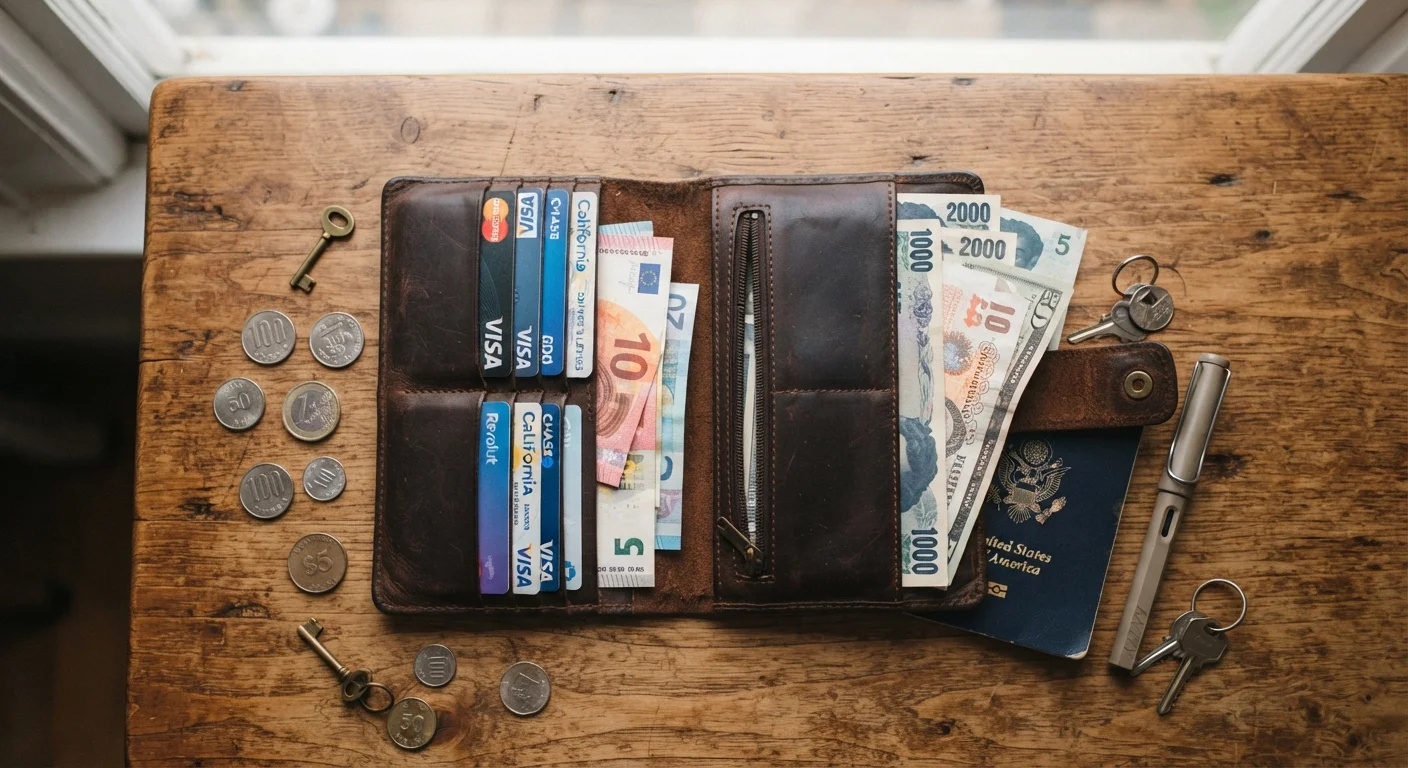
Carrying two cards from different networks (one Visa, one Mastercard, for example) adds a backup if one card is declined or a network has an outage in a particular country. Keep cards stored separately from each other and from your passport.
If your trip takes you through multiple countries with different currencies, plan each currency segment individually rather than exchanging everything at once. Currency you cannot use at your destination has to be converted again, and each conversion carries a cost.
For first-time international travelers still working through the broader pre-trip checklist, our introduction to staying safe abroad covers financial and document safety habits together. Entry requirements, which affect whether you can access your money at all, are covered in our visa and entry requirements guide.