
Travel Smarter

Before You Board: The Pre-Trip Safety Checklist Every Traveler Should Run Through

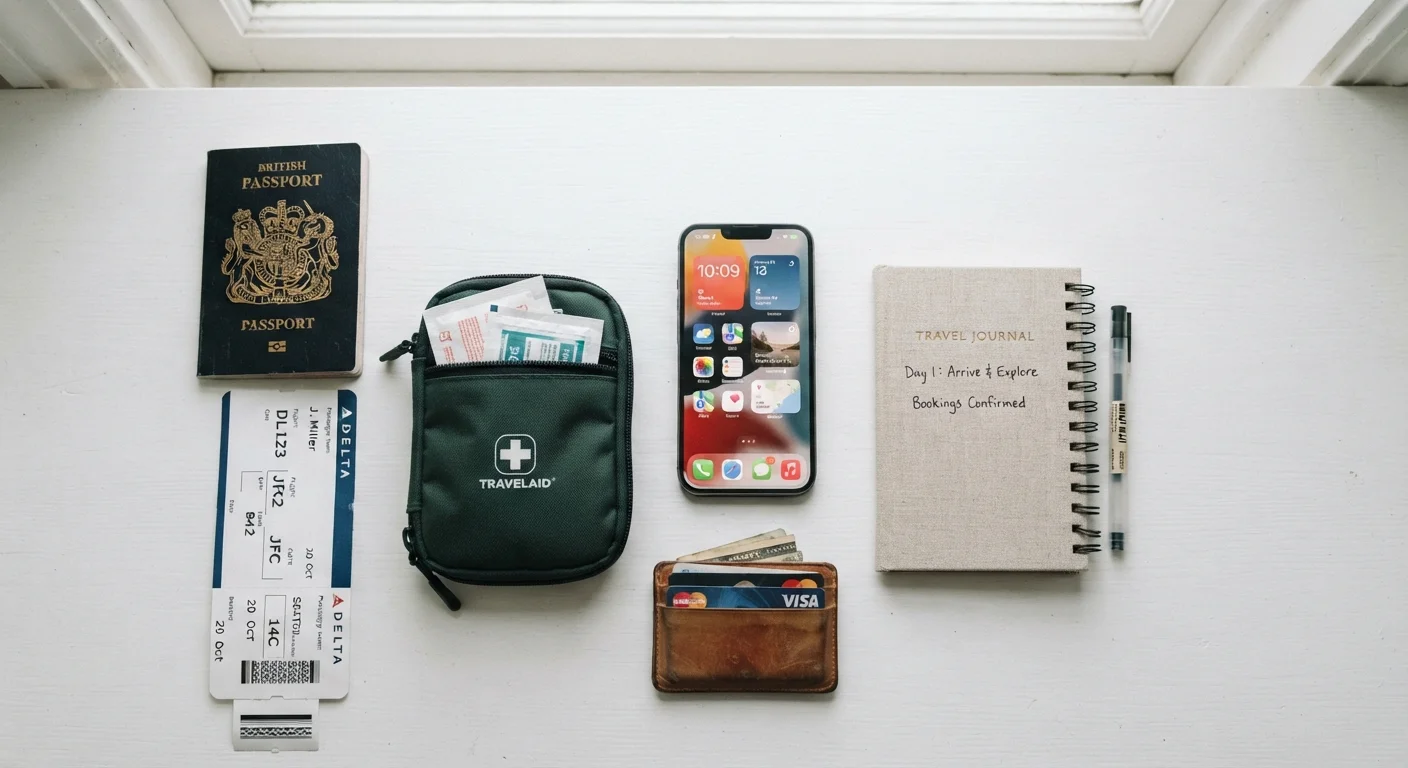
Travel documents, phone, first aid kit, and notebook arranged flat lay on white surface

Key Takeaways

  • Verify every document's expiration date well before departure, not the night before.
  • Travel insurance coverage gaps are most costly when discovered after an incident.
  • A written emergency contact list matters most when your phone battery is dead.
  • Health prep for international travel often requires weeks of lead time.
  • Digital security habits at home protect you from data theft on the road.
30–60 min

Summary

22 items · 30 to 60 minutes

Why a pre-trip safety checklist matters

Most travelers spend hours researching where to eat and what to see, then spend about ten minutes on the preparations that actually protect them if something goes wrong. A missed document, a lapsed insurance policy, or a phone with no offline maps can turn a manageable problem into a serious one.

This checklist covers the areas that matter most: documents and identity, insurance, health preparation, emergency contacts, and digital security. It works for domestic trips as well as international ones, though some items apply specifically to travel abroad. The complete travel safety guide goes deeper on on-the-ground awareness once you arrive.

Work through each group at least a week before departure so you have time to act on what you find. Several items, particularly health-related ones, need weeks of lead time.

Documents and identity

Check that your passport is valid for at least six months beyond your return date, since many countries require this margin for entry. Must
Confirm that any required visas have been obtained and check entry requirements directly with the destination country's official government source, as rules change. Must
Make two physical copies of your passport photo page, visa, and driver's license and store them separately from the originals. Must
Carry a second form of government-issued photo ID in case your primary ID is lost or stolen. Should

Travel insurance

Confirm that your travel insurance policy covers trip cancellation, emergency medical treatment, and medical evacuation for your specific destination. Must
Read the exclusions section of your policy before departure so you understand what is not covered, including pre-existing condition clauses. Must
Write down your policy number, the insurer's 24-hour emergency phone number, and claim instructions on paper, not just in your phone. Must
Check whether your existing health insurance provides any international coverage and, if so, what documentation you would need to file a claim abroad. Should

Health preparation

Schedule a pre-travel appointment with your doctor or a travel medicine clinic at least four to six weeks before an international trip to allow time for any required vaccinations. Must
Carry prescription medications in their original labeled containers and bring a written note from your prescribing physician listing each medication and dosage. Must
Pack a basic first aid kit with bandages, antiseptic, pain reliever, and any over-the-counter medications you rely on, since familiar brands may not be available at your destination. Should
Review the CDC and State Department health advisories for your destination at cdc.gov/travel and travel.state.gov before you go. Should
If you have specific health needs, see traveling with specific health needs for guidance on documentation and medication logistics. Should

Emergency contacts and communication

Write a physical list of emergency contacts: at least one person at home, your accommodation address for each destination, and the local emergency services number (which is not always 911 outside the U.S.). Must
Share your full itinerary, including flight numbers and accommodation names, with at least one trusted person at home who can act as a point of contact. Must
Confirm that your mobile carrier plan covers calls and data at your destination, or arrange a local SIM or portable Wi-Fi device in advance. Should
Download offline maps for each destination area before you leave, so navigation works without a data connection. Should

Digital security

Set a strong PIN or biometric lock on every device you are traveling with and enable remote wipe capability through your device's settings. Must
Avoid logging into banking or sensitive accounts on public Wi-Fi networks; use a virtual private network (VPN) if you need to access private accounts on shared connections. Should
Turn off automatic Wi-Fi connection on your phone so it does not join unknown networks without your knowledge. Should
Notify your bank and credit card providers of your travel dates and destinations to prevent fraud blocks on legitimate transactions. Must

A few things to have on hand

You do not need specialized tools for most of this checklist, but a few resources make the process faster and more thorough.

Required

U.S. State Department travel site (travel.state.gov)

Check current entry requirements, travel advisories, and enroll in STEP for international trips.

Required

CDC Travelers' Health site (cdc.gov/travel)

Review destination-specific health advisories and recommended vaccinations before your appointment.

Required

Secure cloud storage account

Store scanned copies of critical documents so they are accessible if physical copies are lost.

Optional

Offline maps app

Download destination maps before departure so navigation works without a mobile data connection.

Health prep needs more time than you think

Vaccination schedules for destinations in parts of Africa, Asia, and South America can require multiple doses spread over several weeks. Walking into a travel clinic two days before departure may leave you unprotected. Book a travel medicine appointment as early as possible, ideally six or more weeks out. This is general guidance; your doctor is the right person to assess your individual needs.

After you finish the checklist

Once you have worked through all the groups, photograph or scan every critical document: passport, insurance card, travel policy number, and any visas. Store copies in a secure cloud account and email a set to a trusted contact at home.

For international trips, register with the U.S. State Department's Smart Traveler Enrollment Program (STEP) at step.state.gov. Registration is free and lets the nearest embassy contact you in an emergency or during a local crisis.

If you are driving part of the journey, the pre-long-trip vehicle check covers tire pressure, fluids, and lights before you leave the driveway. For the broader planning picture, see the complete trip planning checklist.

This article is for general informational purposes only. For personal medical decisions, consult a qualified healthcare professional. For questions about insurance coverage, read your policy documents and speak with a licensed insurance agent.

Travel Smarter Editorial Team is the collective byline for our editorial team and contributor network. Articles published under this byline or an editorial pen name are researched, written, and reviewed according to our editorial standards for clarity, consistency, and independence before publication.

View all articles by Travel Smarter Editorial Team →
Disclaimer: The content on this site is for informational purposes only and is not a substitute for professional advice. Always consult a qualified professional for guidance specific to your situation.