

Key Takeaways
- The good debt versus bad debt framework is useful but oversimplifies how debt actually works in practice.
- Interest rate, repayment terms, and your financial stability matter more than the debt category alone.
- Even traditionally 'good' debt like a mortgage or student loan can harm finances under the wrong conditions.
- Context, not labels, should guide how you prioritize and manage what you owe.
Where the labels come from
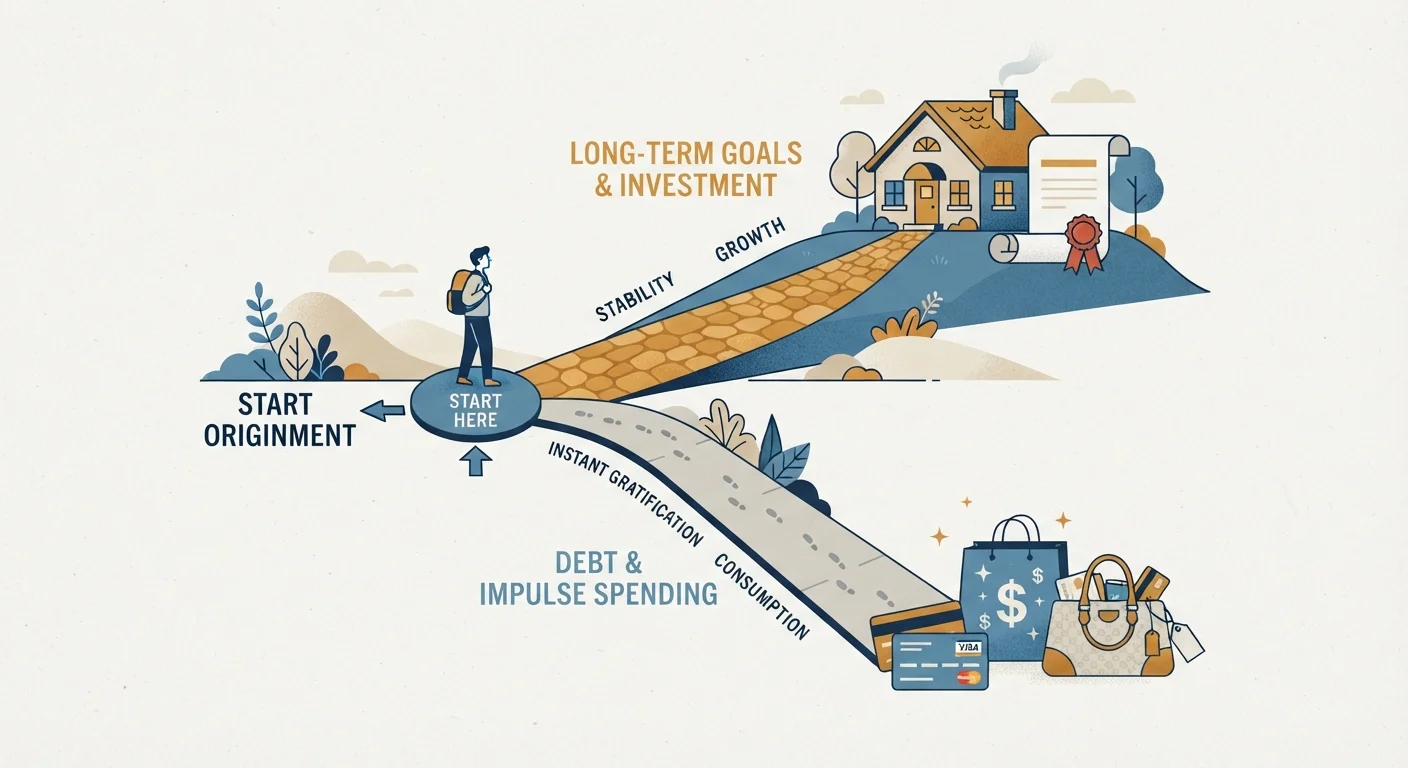
The distinction between good debt and bad debt became common shorthand in personal finance writing during the late twentieth century. The basic idea: debt used to acquire something that grows in value or increases your earning power is good; debt spent on consumption that loses value is bad. Mortgages and student loans landed in the good column. Credit card balances and auto loans landed in the bad one.
That framing is not wrong, exactly. It does capture a real difference in how some debt functions. But it stops short of the more useful question, which is how a specific debt affects a specific person's financial position over time. The label substitutes for that analysis rather than starting it.
Understanding where the framing holds and where it breaks down gives you a more reliable way to evaluate what you owe and what to prioritize next. For a deeper look at how debt categories shape repayment risk, see how secured and unsecured debt differ.
Common myths about good and bad debt
The myths below appear regularly in financial advice. Each one contains a kernel of truth, which is what makes it worth examining carefully rather than accepting at face value.
Myth
A mortgage is always good debt because real estate appreciates over time.
Fact
Real estate can decline in value, and a mortgage is only beneficial if the terms are sustainable for your income and the local market supports appreciation.
Home values rose broadly in many U.S. markets over recent decades, but that trend is not universal or guaranteed. Properties in certain regions have lost value over extended periods, and buyers who purchased near market peaks have sometimes owed more than their homes were worth for years afterward. Beyond price risk, a mortgage with a monthly payment that consumes too large a share of take-home pay can destabilize an entire household budget. The label 'good debt' does not change the math of overextension.
Myth
Student loans are an investment in yourself, so the amount borrowed does not matter much.
Fact
The return on a degree varies widely by field, institution, and labor market conditions, so the amount borrowed relative to expected earnings is what determines whether a student loan is manageable.
A commonly cited guideline in financial planning is to borrow no more for an undergraduate degree than you expect to earn in your first year after graduation. That ratio does not guarantee an outcome, but it gives borrowers a concrete benchmark rather than a blank check justified by the investment framing. Fields with lower median starting salaries and programs at schools with poor completion or employment rates can produce debt loads that take decades to clear, regardless of how the loan was classified at origination.
Myth
Credit card debt is always bad, so paying it off should always come first.
Fact
Credit card debt is typically high-cost and should be prioritized, but the right order depends on rates across all your obligations and whether you have an emergency fund.
If you eliminate a credit card balance while carrying no emergency savings, one unexpected expense can send that balance right back up, often at a higher rate than before. A more stable approach is to build a small cash buffer (enough to cover one to two months of essential expenses) before directing every spare dollar toward debt. This does not mean ignoring high-interest balances; it means structuring repayment so that progress is not immediately reversed by the next car repair or medical bill.
Myth
Auto loans are bad debt because cars depreciate immediately.
Fact
Depreciation makes an auto loan less financially attractive than a mortgage, but the real question is whether the rate and payment fit your budget and whether you needed the vehicle.
Transportation is a genuine necessity for most Americans. A loan that funds reliable transportation to a job paying well above the payment amount is functioning as a tool, not a liability. The problem arises when buyers finance more vehicle than they need, choose long loan terms that keep payments low while maximizing total interest, or roll negative equity from a previous vehicle into a new loan. Those choices, not vehicle depreciation alone, are what makes auto debt expensive. For a detailed look at the financial trade-offs in vehicle purchases, see new versus used car trade-offs.
Myth
Once you label a debt 'good,' you do not need to worry about managing it closely.
Fact
All debt carries obligations and risk. Even low-rate debt can become a problem if your income changes, rates adjust, or the expected return on the underlying asset does not materialize.
A fixed-rate mortgage at a historically low rate still requires monthly payments for decades. A student loan in deferment still accrues interest on unsubsidized balances. Treating debt as benign because it was classified as good at origination can lead to underestimating cumulative interest costs and missing refinancing opportunities when rates shift. Periodic review of all debt, including 'good' debt, is a standard practice in sound personal financial management.
What actually determines whether debt helps or hurts you
Three variables do more work than the good-or-bad label: the interest rate relative to your income and alternatives, whether the debt is manageable within your actual cash flow, and whether the underlying asset or benefit materializes as expected.
A mortgage at a rate that strains your monthly budget leaves you exposed to job loss or rate resets in ways that can erase any equity built up. A student loan that funds a degree in a field with limited job prospects may not generate the income needed to repay it comfortably. Conversely, a short-term personal loan used to consolidate higher-rate balances can reduce total interest paid even though personal loans rarely appear in the good debt column.
The compounding effect of high interest rates over time is worth understanding concretely. The real cost of high-interest debt over time shows how carrying balances works against long-term financial health in measurable dollar terms.
This article is for general informational purposes only and does not constitute personalized financial, legal, or tax advice. Consult a licensed financial professional for guidance specific to your situation.
Building a more useful mental model
Instead of sorting debt into two bins, assess each obligation along a few concrete dimensions. What is the annual percentage rate (APR), and how does it compare to your after-tax investment return potential? Is the payment fixed and predictable, or variable and potentially rising? Does the debt fund something with a realistic and measurable return, or does it fund consumption?
If you carry multiple balances, the order in which you pay them down matters financially. The snowball and avalanche repayment strategies approach that contrast offers a practical framework for deciding which balance to tackle first based on your rates, balances, and motivation. For a broader view of reducing what you owe systematically, the complete guide to getting out of debt covers the full process from audit to sustained progress.
The goal is not to avoid all debt. It is to hold only debt whose terms, purpose, and payment fit within a stable financial plan, and to reduce or exit debt that does not.