
Secured Debt and Unsecured Debt: How the Distinction Shapes Your Repayment Priorities

Key Takeaways
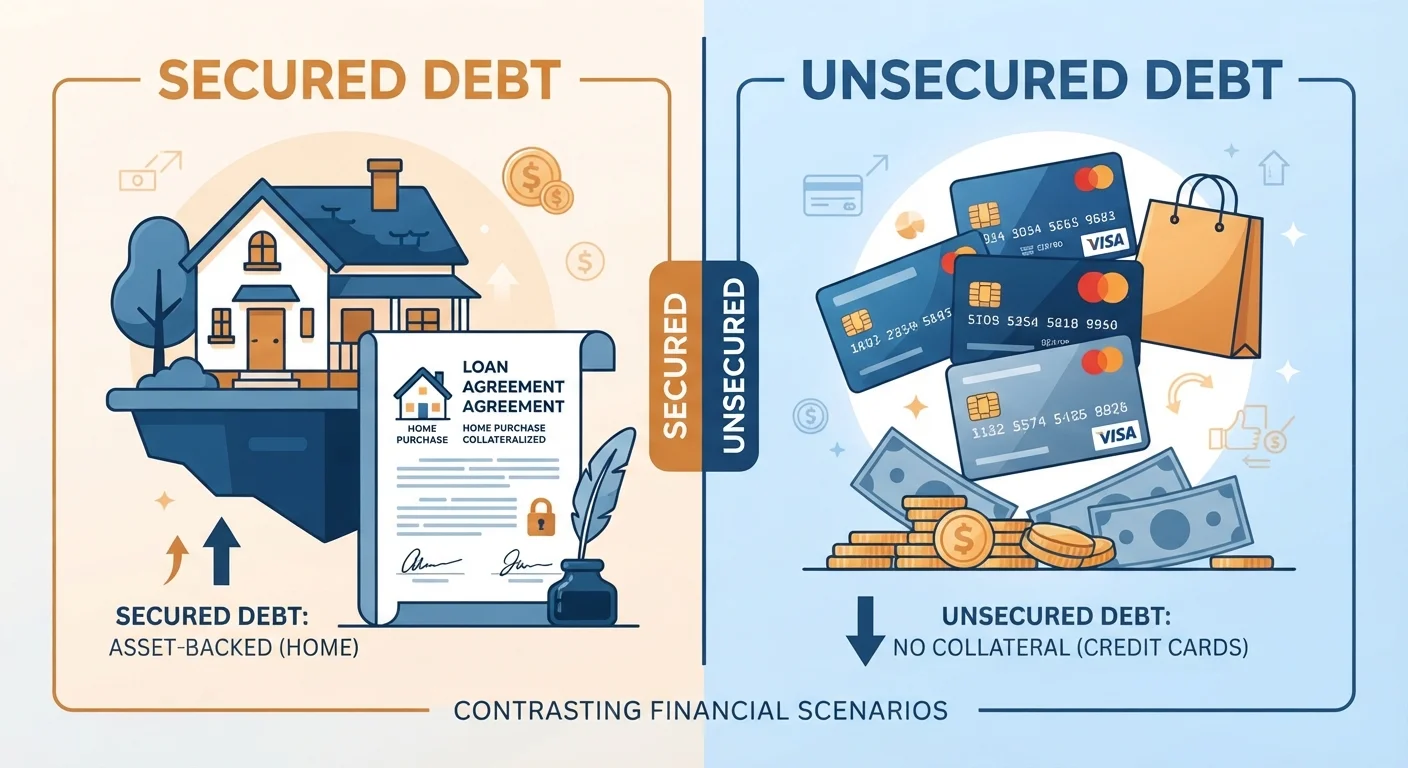
- Secured debt is backed by an asset the lender can seize if you stop paying; unsecured debt carries no such collateral.
- Missing payments on secured debt puts your home, vehicle, or other property at direct risk of repossession or foreclosure.
- Unsecured debt typically carries higher interest rates because lenders accept more risk without collateral backing.
- Repayment priority should reflect both the consequence of default and the interest rate draining your money over time.
- A licensed financial adviser can help you map a repayment sequence suited to your specific balances and income.
Our Verdict
Secured debt demands priority attention because default can cost you your home or vehicle. Unsecured debt, while it cannot strip an asset directly, often carries higher interest rates that accelerate long-term financial damage. The smarter path is to protect secured obligations first, then apply a deliberate strategy to high-rate unsecured balances.
| Best for | Recommended |
|---|---|
| Homeowners or borrowers with a car loan facing cash shortfalls | Prioritize secured debt payments |
| Those managing multiple credit card balances with stable housing costs | Aggressive repayment of high-rate unsecured debt |
| Borrowers juggling both types and feeling overwhelmed | Consult a nonprofit credit counselor or licensed adviser |
What makes debt secured or unsecured
The difference comes down to one question: did you pledge an asset when you borrowed the money?
With secured debt, you did. A mortgage ties the loan to your home. An auto loan ties it to your vehicle. If you stop making payments, the lender has a legal right to take that asset, through foreclosure or repossession, to recover what it is owed. The collateral is the lender's protection against your default.
With unsecured debt, no specific asset backs the loan. Credit cards, medical bills, personal loans, and most student loans fall here. A lender who is not repaid cannot immediately seize your property. Instead, they may report the delinquency to credit bureaus, send the account to collections, or eventually sue you for a court judgment. A judgment can, in some states, lead to wage garnishment, but the path is slower and less direct than secured default.
For a broader view of how debt categories affect financial health, see how debt labels can mislead.
Why the distinction changes what is at stake
The asset backing a secured loan is usually something you depend on daily. Losing a home to foreclosure or a car to repossession disrupts housing, employment, and the ability to meet other obligations. That immediacy is why financial planners generally place secured payments at the top of any repayment hierarchy.
Unsecured default carries real consequences too. A missed credit card payment can push an account into penalty interest rates, damage your credit score for years, and lead to collection calls. However, none of that removes the roof above your head.
| Secured debt | Unsecured debt | |
|---|---|---|
| Collateral required | Yes, an asset is pledged | No asset backing |
| Default consequence | Repossession or foreclosure | Collections, credit damage, possible judgment |
| Typical interest rate | Lower (lender holds collateral) | Higher (lender bears more risk) |
| Common examples | Mortgage, auto loan | Credit card, personal loan, medical bill |
| Repayment priority | High: asset loss risk is immediate | Secondary: after secured obligations are current |
| Speed of lender recovery | Faster via asset seizure | Slower, requires legal process |
Interest rates often run in the opposite direction of risk to the borrower. Because unsecured lenders accept more risk, they typically charge higher rates. A credit card may carry an annual percentage rate several times higher than a fixed-rate mortgage. That means an unsecured balance left unaddressed can compound quickly, a dynamic covered in depth in how high-rate balances grow over time.
Building a repayment priority order
A workable sequence accounts for both the nature of the debt and its cost. A reasonable starting framework:
- Keep secured obligations current first. Mortgage or rent, car payments if the vehicle is essential to income, and any other secured loan where default leads to asset loss.
- Meet minimum payments on all unsecured accounts to prevent penalty rates and collection activity.
- Direct any surplus money toward the highest-rate unsecured balance. Once that is cleared, move to the next highest rate.
This approach protects your most critical assets while systematically reducing the interest drain from unsecured accounts. Some borrowers prefer to pay off the smallest balance first for a psychological boost. That can work if it sustains motivation, but the interest savings from targeting the highest rate are usually larger over time.
Certain habits quietly undermine even a well-structured plan. Recurring patterns that slow repayment are worth examining alongside any priority framework you set.
List every debt before ranking it
Write out each balance with its interest rate, whether it is secured or unsecured, and the consequence of missing a payment. A single clear list prevents the common mistake of sending extra money to a low-rate secured loan while a high-rate credit card compounds in the background. Update the list whenever you pay off a balance or open a new account.
When the standard order needs adjusting
A few situations shift the calculus. If a secured asset has little remaining value and the loan balance exceeds it significantly, the cost-benefit of maintaining payments deserves careful evaluation with a qualified adviser. Similarly, if an unsecured debt has gone to judgment and wage garnishment is active, that effectively becomes a mandatory outflow and may need to move up in priority.
Federal student loans occupy a middle ground. They are unsecured in the traditional sense, but default consequences can include tax refund offsets and wage garnishment without a court order, which is more aggressive than typical unsecured collection. Understanding the specific terms of each loan you carry matters as much as knowing its general category.
Once secured obligations are stable and high-rate debt is under control, directing extra cash toward longer-term goals becomes realistic. Core investing concepts can help frame what that next step looks like.
This article is for general informational purposes only and does not constitute personalized financial, legal, or tax advice. Consult a licensed financial adviser or credit counselor for guidance specific to your situation.