

Key Takeaways
- Fat is an essential macronutrient, not an ingredient to avoid entirely.
- Saturated fat is linked to elevated LDL cholesterol when consumed in excess, according to current dietary guidelines.
- Unsaturated fats, especially from whole food sources, are associated with heart health benefits in the research literature.
- Trans fats from industrial partial hydrogenation are the most clearly harmful type and are largely banned in the US.
- No single food is purely one type of fat; most foods contain a mix of saturated and unsaturated fatty acids.
Dietary fat
Dietary fat is a macronutrient found in both animal and plant foods that the body uses for energy, hormone production, and absorbing certain vitamins. Fat contains more calories per gram than protein or carbohydrates, but that alone does not make it harmful. The type of fat matters more than the total amount in most health discussions.
Fats are classified by their chemical structure, specifically the number and position of double bonds in their fatty acid chains, which determines whether they are saturated, monounsaturated, or polyunsaturated.
Why fat got a bad reputation
Through much of the late twentieth century, dietary fat was framed as the primary cause of heart disease and weight gain. Low-fat products multiplied on supermarket shelves, and fat became something many people tried to eliminate rather than understand. That framing has since been revised considerably by the research community.
The problem was never fat as a category. It was a failure to distinguish between meaningfully different types. Lumping olive oil and industrial shortening into the same conversation produced dietary advice that was both confusing and, in some respects, counterproductive. If you want to make sense of what nutrition labels and health headlines are actually telling you, the starting point is understanding how these fat types differ from one another. For broader context on reading food packaging, this guide to misleading food label claims is worth a read.
Saturated fat: what it is and what the evidence says
Saturated fats have no double bonds in their carbon chain, which makes them solid at room temperature. Butter, lard, full-fat dairy, and the fat found in red meat are familiar examples. Coconut oil, despite being plant-based, is also predominantly saturated.
The concern with saturated fat centers on its effect on low-density lipoprotein (LDL) cholesterol. Elevated LDL is associated with a higher risk of cardiovascular disease, and multiple large studies have found that replacing saturated fat with unsaturated fat reduces LDL levels in many people. The American Heart Association, among other major health bodies, recommends limiting saturated fat to less than ten percent of total daily calories for most adults.
That said, the relationship is not simple. Different saturated fatty acids behave differently in the body, and the food matrix they arrive in matters. Cheese and processed red meat, both high in saturated fat, do not produce identical effects in research comparing them. This is an area where the science continues to develop, and where personal health context matters.
Saturated fat research is still evolving
Some recent analyses have questioned the strength of the link between saturated fat and heart disease when the replacement nutrient and overall diet are taken into account. Replacing saturated fat with refined carbohydrates, for instance, does not appear to reduce cardiovascular risk. The consensus among major health organizations still supports limiting saturated fat, but the nuances are worth knowing when evaluating headlines.
Unsaturated fats: monounsaturated and polyunsaturated
Unsaturated fats contain one or more double bonds in their carbon chain and are liquid at room temperature. They divide into two main groups.
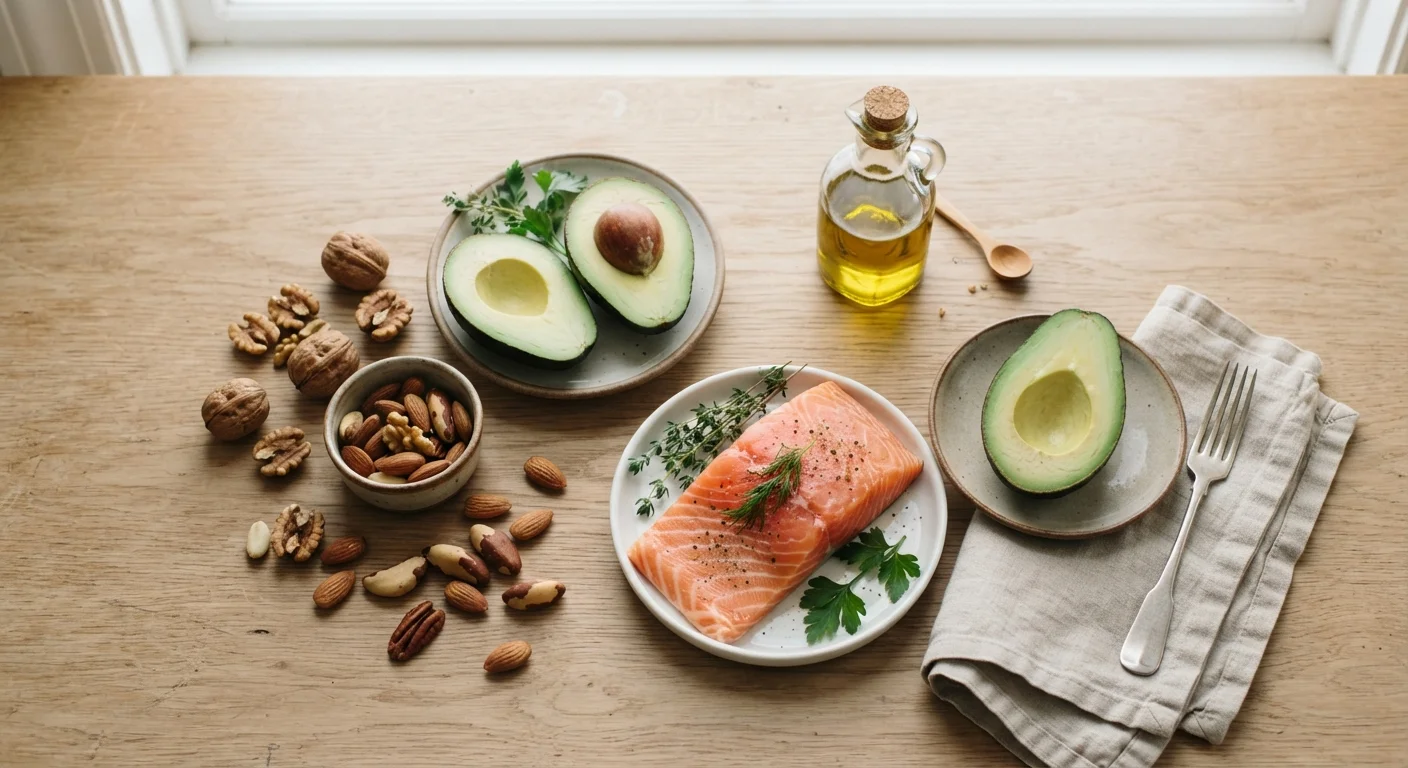
Monounsaturated fats (MUFAs) have one double bond. Olive oil, avocados, most nuts, and canola oil are concentrated sources. Research consistently associates higher MUFA intake with favorable effects on LDL cholesterol and, in some studies, HDL (the so-called good cholesterol).
Polyunsaturated fats (PUFAs) have two or more double bonds. This group includes two families the body cannot make on its own: omega-3 and omega-6 fatty acids. Omega-3s, found in fatty fish like salmon and mackerel, as well as in walnuts and flaxseed, have a well-documented association with reduced inflammation and cardiovascular benefit. Omega-6s are found in many vegetable oils and are also essential, though they are already plentiful in most American diets.
Less than 10%
Recommended daily calories from saturated fat
The Dietary Guidelines for Americans recommend limiting saturated fat to less than 10 percent of total daily caloric intake for adults.
20-35%
Recommended daily calories from total fat
The Dietary Guidelines for Americans suggest this range for most adults, acknowledging that fat type matters alongside total amount.
2018
Year FDA phased out partially hydrogenated oils
The FDA's determination that partially hydrogenated oils are no longer generally recognized as safe took full effect in 2018, largely removing artificial trans fats from the US food supply.
Because digestion shapes how all nutrients reach your cells, understanding the absorption process adds useful context. The article on how food is processed after eating explains this clearly.
Trans fats: the clearest case
Trans fats can occur naturally in small amounts in dairy and ruminant meat, but the form of greatest concern was artificial: partially hydrogenated vegetable oils. The partial hydrogenation process, designed to make liquid oils solid and shelf-stable, produced trans fatty acids that raise LDL cholesterol and lower HDL cholesterol simultaneously, a combination that most researchers consider particularly harmful for cardiovascular health.
The FDA determined that partially hydrogenated oils are no longer generally recognized as safe, and their use in the US food supply was phased out by 2018. Food labels that show 0 grams of trans fat can still legally contain up to 0.5 grams per serving, so checking the ingredient list for partially hydrogenated oils remains a useful habit.
Check the ingredient list, not just the label
Even when a nutrition facts panel shows 0g trans fat, the ingredient list can reveal partially hydrogenated oils in small amounts. If a product contains multiple servings and you consume more than one, those small amounts accumulate. Scanning ingredients takes only a few seconds and gives a more complete picture than the front label alone.
How fats fit into eating patterns
Most foods are not purely one type of fat. A tablespoon of olive oil contains mostly monounsaturated fat but also some saturated and polyunsaturated fat. Salmon contains both omega-3 PUFAs and saturated fat. Treating individual foods as simply good or bad misses the way dietary patterns actually work in the body.
Research on eating patterns, rather than isolated nutrients, tends to produce more consistent findings. Patterns that include fatty fish, nuts, seeds, legumes, and plant oils alongside vegetables and whole grains show stronger cardiovascular benefit than patterns defined only by their fat content in grams. The whole-food context in which fat arrives matters alongside the type and quantity.
If you are building a clearer foundation for interpreting all nutrition information, the nutrition fundamentals guide covers the core concepts in one place. And if a specific diet plan has caught your attention, the overview of fad diet patterns offers a useful framework for evaluating the claims behind it.
This article is for general informational purposes only and is not a substitute for advice from a qualified healthcare provider or registered dietitian. Individual dietary needs vary. Please consult a professional before making significant changes to your diet.