

Key Takeaways
- Dividing your plate visually into food group sections is a reliable alternative to calorie counting.
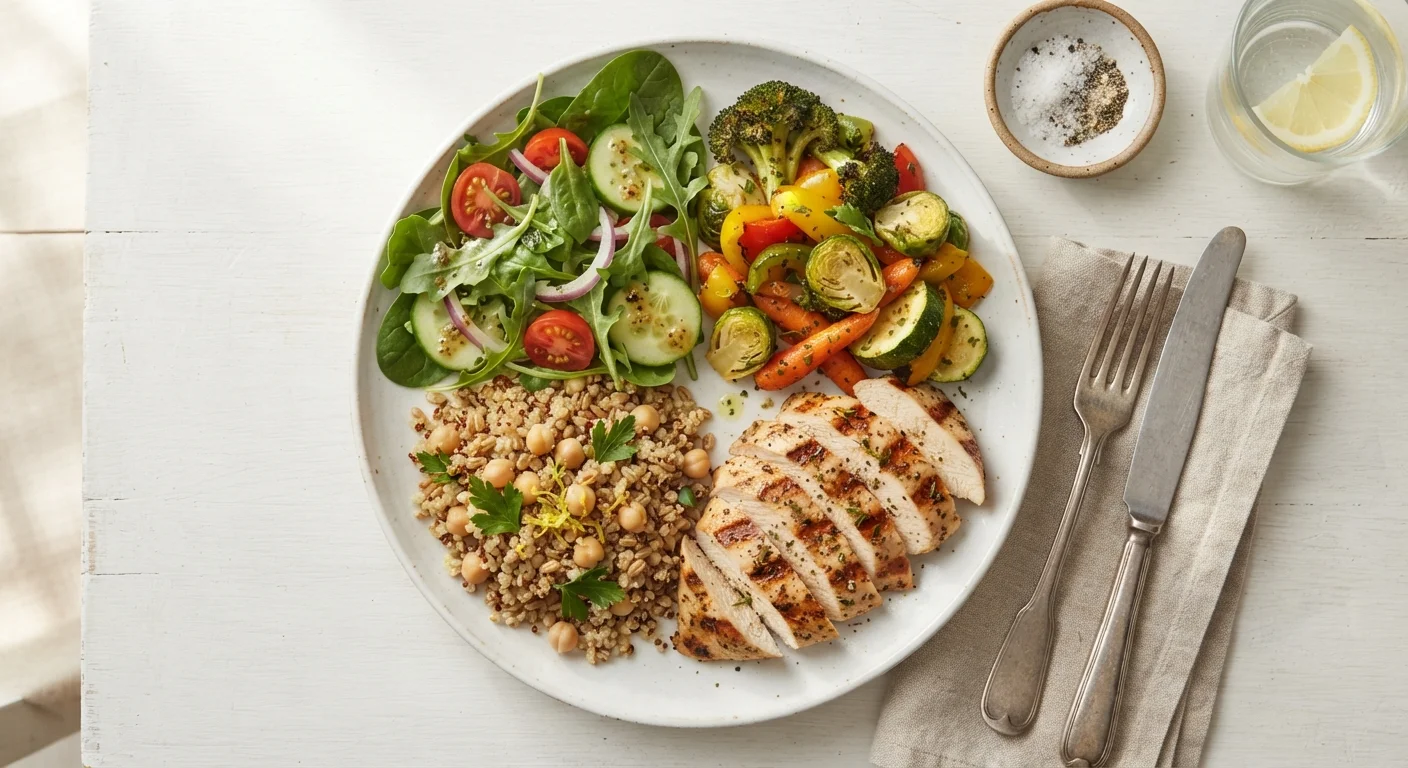
- Half the plate as vegetables and fruit, a quarter as protein, and a quarter as whole grains is a widely supported framework.
- Food quality within each section matters as much as proportions.
- This approach adapts to different cuisines, budgets, and life stages without rigid rules.
- Hunger and fullness cues work alongside visual portioning to guide overall intake.
What you will need
Why visual portioning works
Calorie tracking apps can be useful for some people, but they also require time, consistent access to a device, and nutritional data that is not always accurate. Many people find that logging every meal increases anxiety around food rather than reducing it. Visual portioning sidesteps these issues by turning meal composition into a spatial habit rather than an arithmetic exercise.
The method is grounded in the same nutritional principles that underpin most dietary guidelines. If you fill half your plate with vegetables and fruit, a quarter with a quality protein source, and a quarter with whole grains or starchy vegetables, you naturally distribute macronutrients, fiber, vitamins, and minerals in proportions that support general health. If you want a deeper grounding in the concepts behind this, the fundamentals of nutrition is a good place to start.
This is general dietary information, not a prescription. Individual needs vary by age, health status, activity level, and medical history. A registered dietitian can tailor guidance to your specific situation.
Your plate does not need to be perfect
The plate method is a directional guide, not a scoring system. A meal that is 40% vegetables rather than exactly 50% is still a good meal. Consistency over many meals across many days matters far more than any single plate composition. Give yourself room to adapt the framework to what is actually available and realistic for you.
How to build your plate, step by step
The steps below walk through the visual plate method at the level of a single meal. Apply it consistently across most meals in a day, and the cumulative effect supports a balanced overall eating pattern. You do not need to achieve perfection at every single meal.
Start with vegetables and fruit
Fill half your plate with non-starchy vegetables and, to a lesser extent, fruit. Variety matters here more than any specific choice. Dark leafy greens, cruciferous vegetables, tomatoes, peppers, carrots, and cooked frozen vegetables all count. Color variation across the week is a practical shorthand for nutrient variety.
Raw, roasted, steamed, or sauteed preparations are all fine. The cooking method affects texture and some vitamin levels, but no single method is universally superior for everyday meals.
Add a protein source
Reserve roughly one quarter of your plate for protein. This can come from animal sources such as fish, poultry, eggs, or lean cuts of meat, or from plant sources such as legumes, tofu, tempeh, or edamame. Combining plant proteins across meals helps cover the full range of essential amino acids. How complete and incomplete proteins differ is useful background if you eat mostly or entirely plant-based.
The protein section does not need to dominate the plate. A palm-sized portion for most adults is a reasonable visual guide, though individual needs vary.
Fill the remaining quarter with whole grains or starchy vegetables
Whole grains such as brown rice, quinoa, oats, barley, or whole-wheat bread provide fiber and B vitamins that refined grains deliver in smaller amounts. Starchy vegetables like sweet potato, corn, or peas are equally suitable in this section.
The distinction between nutrient density and caloric density is relevant here. Two portions of carbohydrate can carry the same number of calories but very different fiber, vitamin, and mineral content. Understanding nutrient density explains why this distinction changes how you think about food choices within a given plate section.
Include a healthy fat source
Fat does not occupy its own plate section, but it belongs in the meal. A drizzle of olive oil used in cooking, a small portion of avocado, a handful of nuts or seeds, or a dressing made with an oil-based base all provide unsaturated fats that support nutrient absorption and satiety.
Portion awareness applies here because fat is calorie-dense, but the goal is inclusion rather than avoidance. Meals without adequate fat often leave people hungry sooner, which can affect overall eating patterns throughout the day.
Check in with your hunger and fullness
Visual portioning sets up the composition of a meal, but it does not account for how much food a given person needs on a given day. After plating your food, eat slowly enough to notice when fullness builds. This is not about stopping at a fixed point: it is about staying connected to physical signals rather than eating on autopilot.
How hunger and satiety hormones work gives useful context for why some meals leave you satisfied for hours while others wear off quickly. Understanding those signals helps you adjust portion sizes sensibly rather than by guesswork.
Making the method work across different situations
Mixed dishes such as stir-fries, curries, soups, and grain bowls do not sit neatly on a divided plate. For these, use the same proportions as a rough mental guide: roughly half the volume as vegetables, a palm-sized amount of protein, and a fist-sized portion of grains or starchy base. A bowl of lentil soup with a side salad, for example, satisfies the framework even though no physical plate division is involved.
Nutrition needs shift over a lifetime, and the plate method adapts with them. How dietary priorities change across life stages is worth reading if you are building eating habits for children, older adults, or during pregnancy; those groups benefit from explicit professional guidance alongside any general framework.
If you notice that certain food groups feel consistently absent from your meals, it may be worth checking whether specific nutrients are going short. Iron, calcium, and vitamin D are among the nutrients many people under-consume even when their overall diet looks reasonable.
Snacking fits into this approach too. A snack that resembles a small version of the plate method, for instance, raw vegetables with a protein-containing dip, fits naturally. Whether snacking supports or works against your nutrition depends on composition and timing, not on snacking itself.