

Key Takeaways
- Spark plugs wear gradually, so performance loss often goes unnoticed until the problem is significant.
- Most manufacturers recommend replacing spark plugs between 30,000 and 100,000 miles depending on plug type.
- A misfiring cylinder can trigger the check-engine light and reduce fuel economy noticeably.
- Visual inspection of a removed plug reveals a lot about combustion health and engine condition.
- Ignition coils and wires can fail independently of plugs and produce identical symptoms.
Spark plug and ignition system
A spark plug is a small threaded device that screws into each engine cylinder and delivers a timed electrical spark to ignite the air-fuel mixture. The ignition system includes the coils, wires, and control electronics that generate and route that high-voltage pulse. Together, these components fire in precise sequence thousands of times per minute whenever the engine runs.
Most modern vehicles use a coil-on-plug (COP) design, placing an individual ignition coil directly on each spark plug rather than routing voltage through shared wires, which reduces energy loss and misfires.
What spark plugs actually do
Every gasoline engine depends on a precisely timed spark to convert fuel into motion. The spark plug sits at the top of each cylinder and fires an electrical arc across a small gap between two electrodes. That arc ignites the compressed air-fuel mixture, driving the piston down and producing power. Do this millions of times over the life of the engine, and the electrode metal erodes, the gap widens, and ignition becomes less reliable.
The rest of the ignition system feeds the plug. An ignition coil steps up battery voltage to tens of thousands of volts. In older vehicles, a distributor routed that voltage through plug wires to each cylinder in sequence. Most vehicles built in the past two decades use coil-on-plug (COP) systems, where a coil sits directly on each plug. Either way, the coil, the connection, and the plug all need to be in good shape for combustion to work correctly.
This is part of the broader picture covered in the complete guide to keeping your car in peak condition, which walks through every major system in sequence.
Signs that the ignition system needs attention
Worn spark plugs rarely announce themselves all at once. The electrode gap grows slowly, the spark weakens gradually, and the engine compensates to a point. By the time most drivers notice something is wrong, the ignition system has already been running below spec for some time.
The most common signals are a rough idle, hesitation when accelerating, and a drop in fuel economy. A flashing check-engine light specifically indicates an active misfire, meaning one or more cylinders are not firing on every stroke. Ignoring a persistent misfire can damage the catalytic converter, which is an expensive repair.
Hard starting in cold weather is another indicator. Spark plugs that fire reliably at normal operating temperature may struggle when the engine is cold and the mixture is harder to ignite. Seasonal maintenance checks are a practical time to assess ignition condition before temperatures drop.
Check the interval in your owner's manual
Manufacturer-recommended replacement intervals vary widely by engine and plug type. The owner's manual lists the correct interval and plug specification for your vehicle. Using the wrong heat range plug can cause fouling or pre-ignition, so the spec matters as much as the timing.
Reading a spark plug: what the electrode tells you
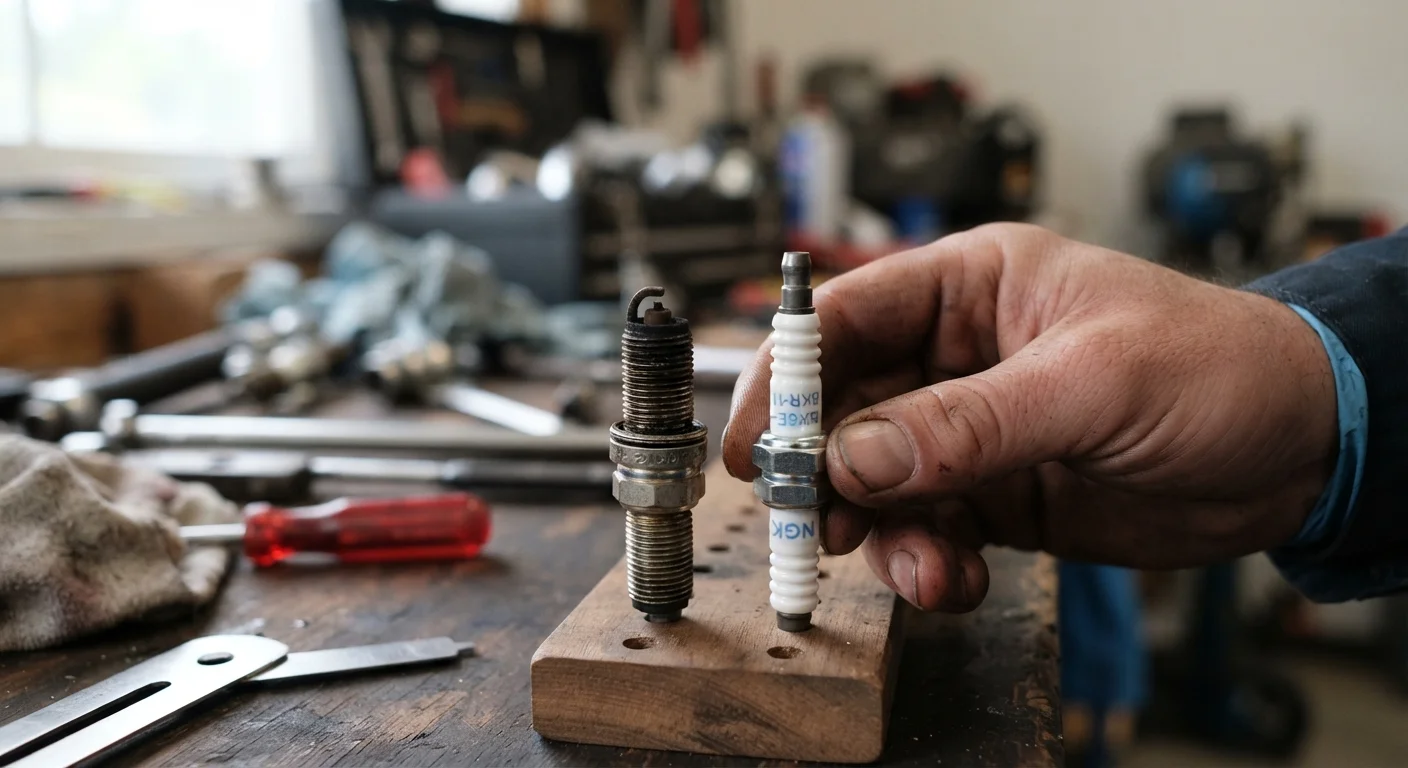
A removed spark plug carries a record of combustion conditions. A healthy plug has a light tan or gray deposit on the ceramic insulator and a square electrode with a defined edge. Deviations from that pattern point to specific problems.
- Black, sooty deposits suggest a rich fuel mixture or a cold-running engine.
- Oil fouling, where the insulator looks wet and dark brown, points to oil entering the combustion chamber, often from worn valve seals or piston rings.
- A white or blistered insulator indicates overheating, either from an incorrect plug heat range or a cooling system issue.
- A worn, rounded electrode with a visibly widened gap is simply an aged plug past its service life.
Any of these patterns warrants further diagnosis, not just a plug replacement, because the plug is showing a symptom rather than being the root cause.
30,000 mi
Typical copper plug replacement interval
Standard copper-core spark plugs generally reach the end of their service life around 30,000 miles under normal driving conditions.
Up to 100,000 mi
Extended life iridium plug interval
Iridium-tip spark plugs are rated by many manufacturers for up to 100,000 miles, though actual wear depends on engine condition and driving habits.
4 to 8
Spark plugs in a typical passenger vehicle
Most four-cylinder engines use four plugs; six- and eight-cylinder engines use six or eight respectively, with some performance engines using two plugs per cylinder.
Coils, wires, and the parts drivers forget
Spark plugs get most of the attention at service time, but the coils and plug wires that deliver voltage are equally wear-prone. Ignition coil failure is common on high-mileage engines and produces the same misfire symptoms as a bad plug. On COP systems, each coil is relatively inexpensive, and shops often replace the coil and plug together on the affected cylinder.
On vehicles with plug wires, the insulation cracks with age and heat, causing voltage to arc to ground before reaching the plug. Wires are generally replaced as a set when worn, since the insulation on all of them ages at the same rate.
Drivers maintaining older, higher-mileage vehicles should give the full ignition system closer attention, not just the plugs. The maintenance priorities for high-mileage vehicles article covers which systems need closer scrutiny as odometer numbers climb.
This article provides general vehicle maintenance information for educational purposes. Always consult a qualified mechanic before performing repairs, and refer to your vehicle's owner's manual for manufacturer-specific service intervals and specifications.