

Key Takeaways
- Coolant circulates between the engine and radiator to carry heat away from combustion surfaces.
- The thermostat controls coolant flow and keeps the engine at its designed operating temperature.
- A failing water pump, low coolant level, or blocked radiator are the most common causes of overheating.
- Coolant degrades over time and should be flushed on the interval listed in your owner's manual.
- An overheating warning light or temperature gauge spike means stop driving as soon as it is safe to do so.
Vehicle cooling system
A vehicle's cooling system is a network of components that removes excess heat from the engine and releases it into the surrounding air. Without it, combustion heat would quickly destroy engine parts. The system circulates a liquid mixture of coolant (antifreeze) and water through passages in the engine block and cylinder head, then through the radiator where the heat dissipates.
Most modern passenger vehicles use a pressurized, closed-loop liquid cooling system. Pressurizing the system raises the boiling point of coolant, allowing it to absorb more heat before vaporizing.
How the cooling system circulates heat
An internal combustion engine generates enormous heat during normal operation. Left unmanaged, that heat would warp metal components and cause engine failure within minutes. The cooling system exists to move that heat out of the engine and into the air before damage occurs.
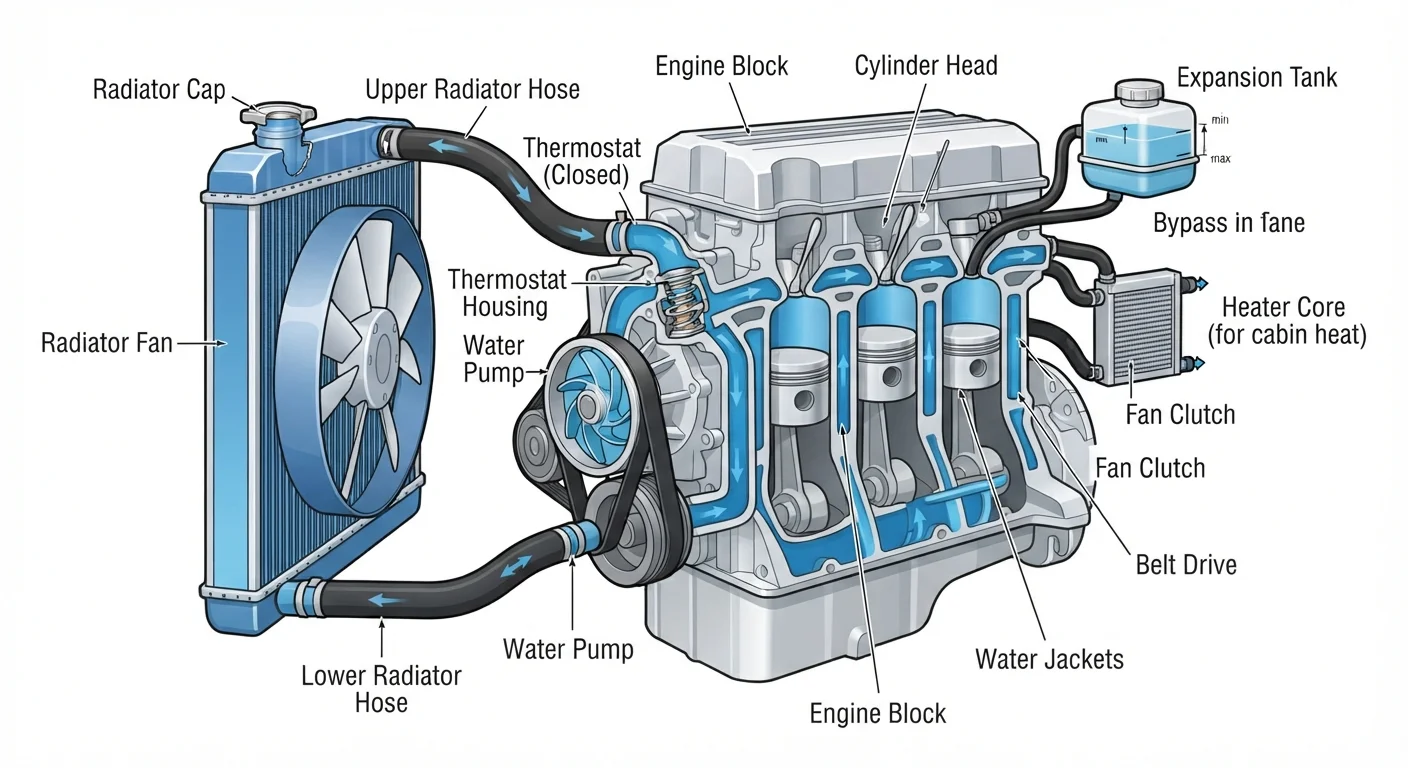
The process follows a continuous loop. The water pump, driven by a belt from the engine crankshaft, pushes coolant through channels cast into the engine block and cylinder head. There, the fluid absorbs heat directly from combustion surfaces. The hot coolant then travels through the upper radiator hose to the radiator, a flat heat exchanger mounted at the front of the vehicle. Air passing through the radiator fins (either from forward motion or from the electric cooling fan) strips heat from the coolant, and the cooled fluid returns to the engine through the lower hose.
The thermostat sits at the engine's coolant outlet and acts as a gatekeeper. When the engine is cold, the thermostat stays closed, keeping coolant inside the engine to let it warm up faster. Once coolant reaches the target temperature (typically around 195 to 220 degrees Fahrenheit depending on the vehicle), the thermostat opens and allows circulation through the full loop. A thermostat stuck in the closed position will cause rapid overheating; one stuck open will keep the engine running too cool, reducing fuel efficiency and increasing wear.
The overflow reservoir (also called the coolant expansion tank) handles the volume changes that occur as coolant heats and cools. It also gives you a visible reference point for checking coolant level without touching the pressurized radiator cap.
Why overheating happens and how to recognize it
Overheating almost always traces back to one of four conditions: low coolant level, a failed water pump, a blocked radiator, or a blown head gasket.
- Low coolant level from a leak means there is not enough fluid to absorb engine heat. Leaks can occur at hose connections, the water pump seal, the radiator itself, or internally if the head gasket fails.
- A worn water pump impeller cannot move coolant at the required flow rate, so heat builds up even when coolant volume is correct.
- A radiator clogged with scale, corrosion, or debris cannot dissipate heat efficiently, even with coolant flowing through it.
- A blown head gasket allows combustion gases into the cooling system, introducing air pockets and contaminating the coolant with exhaust byproducts.
The temperature gauge on your dashboard and the coolant warning light are your primary indicators. A gauge climbing toward the red zone or an illuminated warning light means the system is not keeping up with heat load. White smoke from the exhaust, a sweet smell near the engine bay, or visible coolant puddles under a parked vehicle are all signs worth investigating promptly.
Check the reservoir, not the radiator cap
On modern vehicles, the plastic overflow reservoir is the correct place to check and add coolant. The reservoir is marked with MIN and MAX lines and is safe to inspect when the engine is cold. Opening the pressurized radiator cap on a hot engine can cause scalding burns from steam and pressurized fluid.
For a broader look at the maintenance intervals that protect high-mileage engines, see maintenance priorities for high-mileage vehicles.
Routine cooling system maintenance
Coolant does not last indefinitely. The corrosion inhibitors in the fluid break down over time, allowing acids to form that attack aluminum components, rubber hoses, and the water pump seal. A coolant flush removes degraded fluid and replaces it with fresh mixture before that damage accumulates.
Beyond coolant replacement, a complete cooling system inspection covers hose condition (look for cracks, soft spots, or swelling at the clamps), the radiator cap (which maintains system pressure and should be tested periodically), and the condition of the drive belt that powers the water pump.
Hoses are often overlooked because they appear fine on the outside while the inner lining deteriorates. Squeezing a cold hose is a simple check: a hose that feels very soft, very hard, or gritty inside may be near failure. Replacement is inexpensive compared to the tow and repair bill from a burst hose on the highway.
If you want a complete schedule of fluid checks and maintenance tasks, the complete car maintenance guide covers every system in detail. Drivers preparing for temperature extremes should also review seasonal preparation for winter and summer, since both heat and cold put additional demands on the cooling system.
This article is for general informational purposes only. Always consult a qualified mechanic before performing repairs or if you are uncertain about your vehicle's condition.