

Key Takeaways
- Every international arrival follows roughly the same sequence: immigration, baggage claim, then customs.
- Airport signs use standardized symbols that are readable even when you cannot read the local language.
- Having your passport, arrival card, and accommodation address ready before you reach the immigration queue saves time.
- Always verify entry requirements and customs rules with official government sources before you travel.
- Transit passengers who leave the secure zone may need a transit visa, which must be arranged in advance.
Start here
What happens when you land
Next
Reading airport signage in an unfamiliar language
Then
Customs, immigration, and baggage claim
Finally
Getting out of the airport
What happens when you land
The aircraft door opens and passengers file into a jet bridge or onto a bus. From that moment, the airport process follows a predictable sequence that is roughly the same at every international destination: immigration, baggage collection, and customs. Understanding the order removes most of the anxiety.
Before you reach the immigration desk, you will typically pass through a health screening zone (more common in some regions than others) and collect an arrival card if the country requires one. If the airline did not distribute arrival cards on the flight, dispensers or staff are usually present near the immigration hall entrance. Fill the card out completely, including your accommodation address, even if the stay is a hotel booking rather than a home.
For transit passengers who are connecting to another flight without leaving the secure zone, the process is different. If you are connecting, follow signs marked transit or transfer and do not join the immigration queue unless instructed. See the guide on connecting flights and layovers for a detailed look at when transit visas are required and how to handle tight connection times.
Immigration (passport control)
The border checkpoint where an officer checks your passport and verifies you have permission to enter the country. It is not the same as customs.
Arrival card
A short paper or digital form you fill out before reaching immigration, listing your passport details, purpose of visit, and local address. Not every country requires one.
Customs
The checkpoint after baggage collection where authorities check that you are not bringing in goods above duty-free limits or items that are restricted or prohibited.
Transit passenger
A traveler who lands at an airport only to connect to another flight, without intending to enter the country formally. Some countries require a transit visa even for this.
Baggage receipt
A sticky label attached to your boarding pass when you check a bag. It has a barcode that identifies your luggage and is needed if a bag is lost or delayed.
Duty-free allowance
The quantity of certain goods (alcohol, tobacco, gifts, cash) you are permitted to bring into a country without paying import tax. The limit varies by country.
Reading airport signage in an unfamiliar language
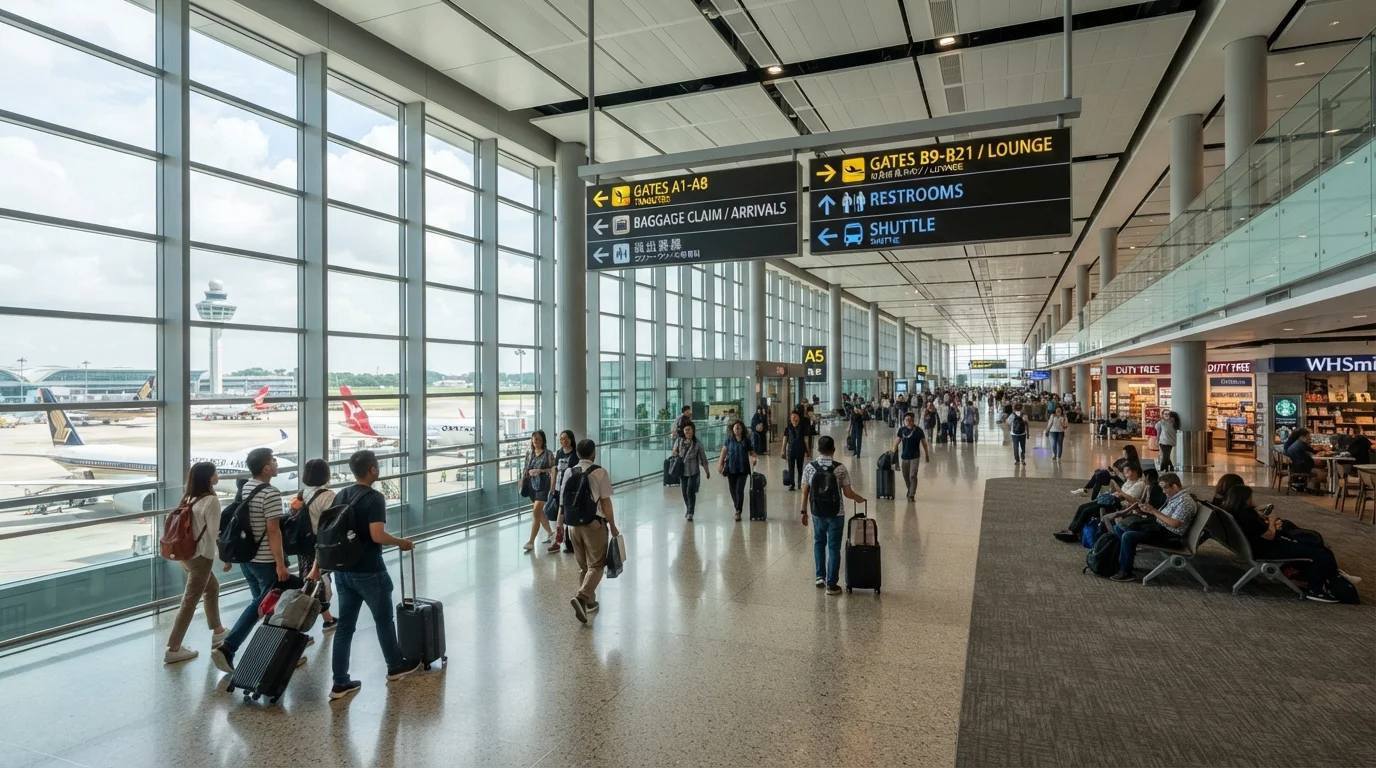
International airports use a set of pictograms that the International Air Transport Association and the International Civil Aviation Organization have promoted for decades. These symbols appear consistently across most major airports: a suitcase for baggage claim, a passport booklet for immigration and passport control, a walking figure with an arrow for exit directions, and a bed or house symbol for transit hotels.
Color coding also follows broad conventions. Blue or green signs typically indicate general passenger information and directions. Yellow or orange signs often indicate caution zones or construction detours. Red is reserved for restricted areas. You do not need to read local script to act on these cues.
When you are genuinely unsure, airport staff and information desks are available in every major terminal. Staff in international areas usually speak English or can direct you to someone who does. Pointing to your boarding pass and asking for the baggage claim or exit is universally understood.
A translation app with a camera feature can read printed signs in real time. Download one with offline capability before you travel, as airport Wi-Fi can be slow in congested arrival halls.
Customs, immigration, and baggage claim
The immigration desk is where an officer examines your passport and any visa or entry documentation. Have these ready before you reach the counter. Look at the officer, answer questions briefly and honestly, and avoid over-explaining. Common questions cover your purpose of visit, length of stay, and where you will be staying. The officer may take a digital photo or fingerprints as part of the entry record.
After immigration, follow signs to the baggage claim hall. Screens near the carousel area list flight numbers alongside a carousel number. Match the number on the screen to your flight number on your boarding pass. Bags from international long-haul flights can take 20 to 40 minutes to appear after landing, so allow time before assuming something is wrong.
Once you have your bags, you will pass through customs. Most airports offer a dual-channel system: a green channel for nothing to declare and a red channel for goods above duty-free limits or restricted items. Check the destination country's customs authority website for current allowances on alcohol, tobacco, currency, and food items. Customs rules vary significantly between countries, and using the wrong channel can carry a financial penalty.
Photograph your checked bag before you fly
Take a quick photo of your suitcase before dropping it at check-in. If the bag is lost or delayed, the photo helps airline staff identify it accurately. Store the image in your phone's camera roll so it is accessible without internet.
If a customs officer stops you for a random check in the green channel, cooperate calmly. Random checks are routine and do not imply suspicion. Traveling with receipts for high-value electronics or jewelry can help resolve questions quickly.
For broader safety habits to carry through your whole trip, see our guide for first-time international travelers.
Getting out of the airport
The arrivals hall is usually the first public area beyond the customs exit. This is where greeters, drivers, and meeters wait. If someone is collecting you, agree on an exact meeting point before your flight departs, since large airports can have multiple exits from the arrivals hall.
Ground transportation options vary by airport: official taxis, ride-hail apps, pre-booked private transfers, airport rail links, and public buses are common. Look for the official taxi rank rather than accepting unsolicited offers from drivers inside the terminal. Many countries have licensed taxi queues managed by airport staff, and these are generally safer and fairly priced compared to informal approaches.
Currency exchange counters appear in most arrivals halls, though their rates are rarely favorable. If you need local cash immediately, an ATM inside the airport is usually a better option for the exchange rate. Plan your payment approach before you land. The overview of currency and payment strategies covers how to think through cash and cards before leaving home.
Always verify entry requirements, customs rules, and ground transportation options through official government and airport sources before your trip. Conditions can change, and no article can substitute for checking current official guidance.