

Key Takeaways
- Oversized bags are the most common reason travelers face gate-check fees or delays at boarding.
- Liquids rules catch experienced travelers off guard just as often as first-timers.
- Packing essentials in checked luggage is a risk: bags get delayed or lost more often than many expect.
- Where items sit inside your bag determines how smoothly you move through security.
- A carry-on packed without a plan wastes more usable space than most travelers realize.
Why carry-on packing goes wrong
Most carry-on mistakes do not come from carelessness. They come from packing at home while imagining a smooth, frictionless journey, then meeting the reality of a crowded security lane, an overhead bin that is already full, or a gate agent with a bag sizer. The gap between those two moments is where errors live.
The rules around carry-on travel are not complicated, but they are specific, and airlines apply them inconsistently enough to lull frequent travelers into false confidence. A bag that sailed through unchallenged on your last trip can be flagged on this one, depending on the aircraft, the load, or the individual gate crew.
The mistakes below are among the most common, and each one has a clear fix. For a broader look at how minimalist packing changes the entire travel experience, see the logic behind one-bag travel.
Assuming your bag meets size limits without measuring it.
Why it happens: Airlines publish maximum dimensions, but travelers often buy bags labeled 'carry-on' without verifying the measurements match their specific airline's policy.
Packing liquids, gels, or aerosols without following the TSA 3-1-1 rule.
Why it happens: The rule is familiar in principle, but travelers underestimate volumes, forget items like toothpaste or sunscreen, or pack the clear bag too full to reseal properly.
Putting essential medications and valuables in checked luggage.
Why it happens: Travelers sometimes move items to checked bags when a carry-on feels full, without thinking through what happens if that bag is delayed or lost.
Packing a bag so tightly that it cannot compress to fit the overhead bin.
Why it happens: Many travelers pack to the absolute limit of what a bag can hold, without accounting for the fact that overhead bins vary in size and a hard-sided bag has no give.
Burying items needed at security or mid-flight deep inside the bag.
Why it happens: Travelers pack for destination convenience rather than travel-day convenience, which puts frequently needed items at the bottom.
Ignoring the personal item as usable space.
Why it happens: Many travelers treat the personal item slot as a place for a purse or a thin laptop bag, not realizing it can carry a meaningful portion of the trip's contents.
How to use your carry-on more effectively
Getting the packing right is one part of the equation. Knowing how to move through the airport with that bag is the other. Travelers who breeze through security have usually packed with the checkpoint in mind, not just their hotel room.
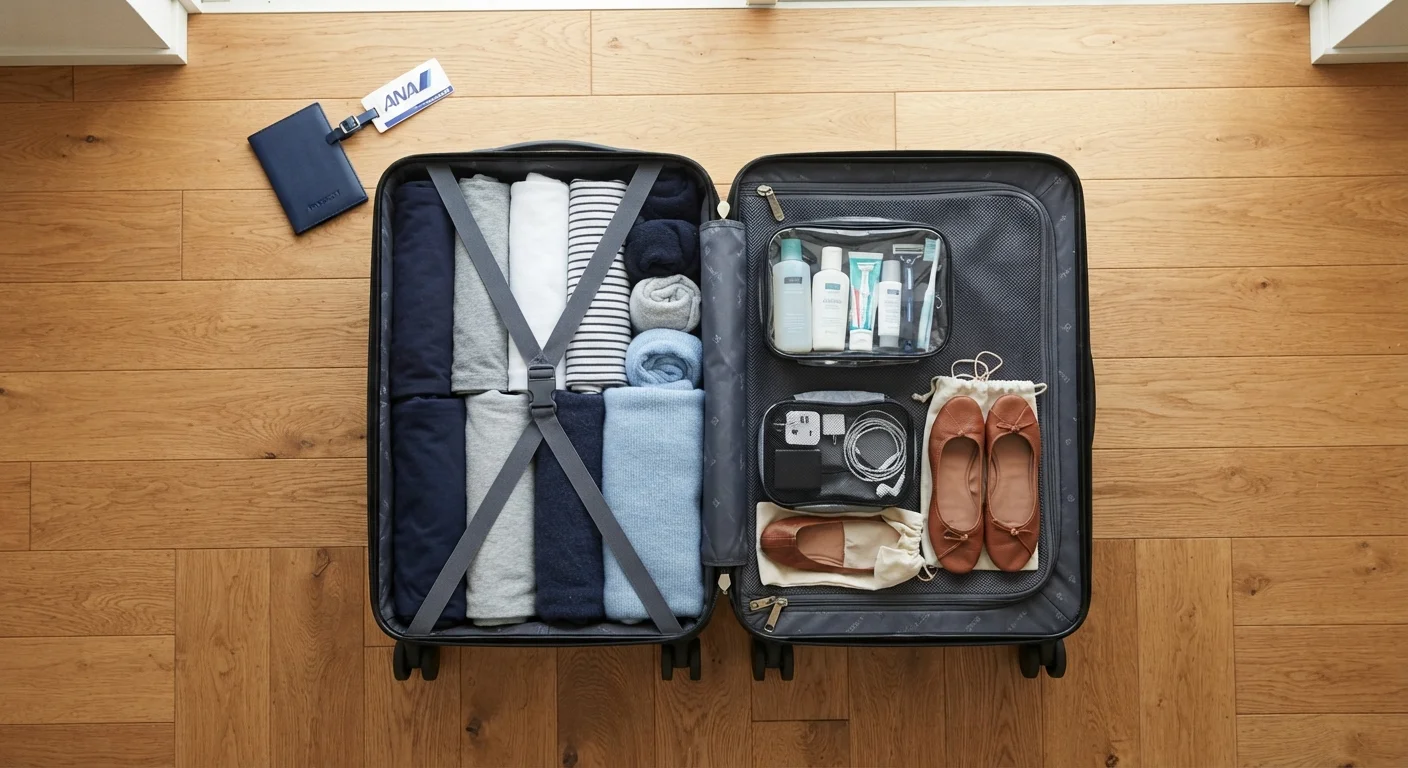
Put electronics and your clear liquids pouch near the top or in an external pocket so they come out fast. Keep shoes accessible if you are traveling through a checkpoint that requires removing them. Place anything you will need mid-flight, such as headphones, a book, or a light layer, in the same accessible zone so you are not unloading the overhead bin thirty minutes after takeoff.
Gate-check fees are not always avoidable
On many low-cost carriers, if your bag does not fit the sizer at the gate, you will pay to check it there and then. This fee is often higher than a standard checked bag fee booked in advance. Knowing your airline's exact dimensions before you leave home is the only reliable way to avoid it. Rules for basic economy and budget fares are stricter than standard tickets on the same airline.
If your itinerary includes connecting flights, the carry-on strategy matters even more. Tight connections leave no time to repack or check a bag at the gate. Connecting flights and layovers involve more variables than most travelers anticipate, and a well-packed carry-on gives you more flexibility when timing gets tight.
Packing well also affects your travel budget. Gate-check fees, overweight charges, and last-minute purchases of forgotten items add up. Travel budgets run short for exactly these kinds of unplanned costs, and carry-on discipline is one of the easier ways to avoid them.