

Key Takeaways
- Puppies learn through consequences, so what happens immediately after a behavior shapes whether it repeats.
- Positive reinforcement means adding something the puppy values right after the desired behavior occurs.
- Timing a reward within one to two seconds of the behavior is what connects the action to the outcome in the puppy's brain.
- Consistency across everyone in the household matters more than the number of training sessions.
- Low-distraction environments help puppies learn new skills before those skills can be practiced in harder settings.
Start here
Why mental models matter before commands do
Core concept
How reinforcement actually works
Critical skill
Timing: the single variable owners underestimate most
Apply it
Consistency, environment, and realistic expectations
Why mental models matter before commands do
Most people start puppy training by searching for the right command words. What actually determines success is something earlier: understanding how a puppy's brain connects behavior to outcome. Without that, even a perfect sit-stay script falls apart in the living room.
Puppies do not arrive with a sense of human rules. They arrive with a learning system that has been operating since birth: behaviors that produce good outcomes tend to repeat, and behaviors that produce nothing (or something unpleasant) tend to fade. That system is operating whether or not you are intentionally training. Every interaction either teaches something or teaches the opposite of what you wanted.
This is good news. It means you do not need to find a magic technique. You need to understand one core mechanism and apply it deliberately. If you are also preparing your home for a first pet, the first-time owner guide covers the broader setup context that pairs well with these training foundations.
Positive reinforcement
Adding something the learner values immediately after a behavior, which makes that behavior more likely to happen again.
Marker signal
A short, consistent sound or word (such as 'yes') delivered at the exact moment of a correct behavior to tell the puppy precisely what earned the reward.
Generalization
The ability to perform a learned behavior in different places, around different distractions, and with different people, not just in the original training setting.
Reinforcement window
The roughly one-to-two-second gap after a behavior during which a reward must arrive to connect that reward to the behavior in the puppy's brain.
Extinction
The gradual fading of a behavior when it consistently produces no consequence, including no attention or reaction from people nearby.
How reinforcement actually works
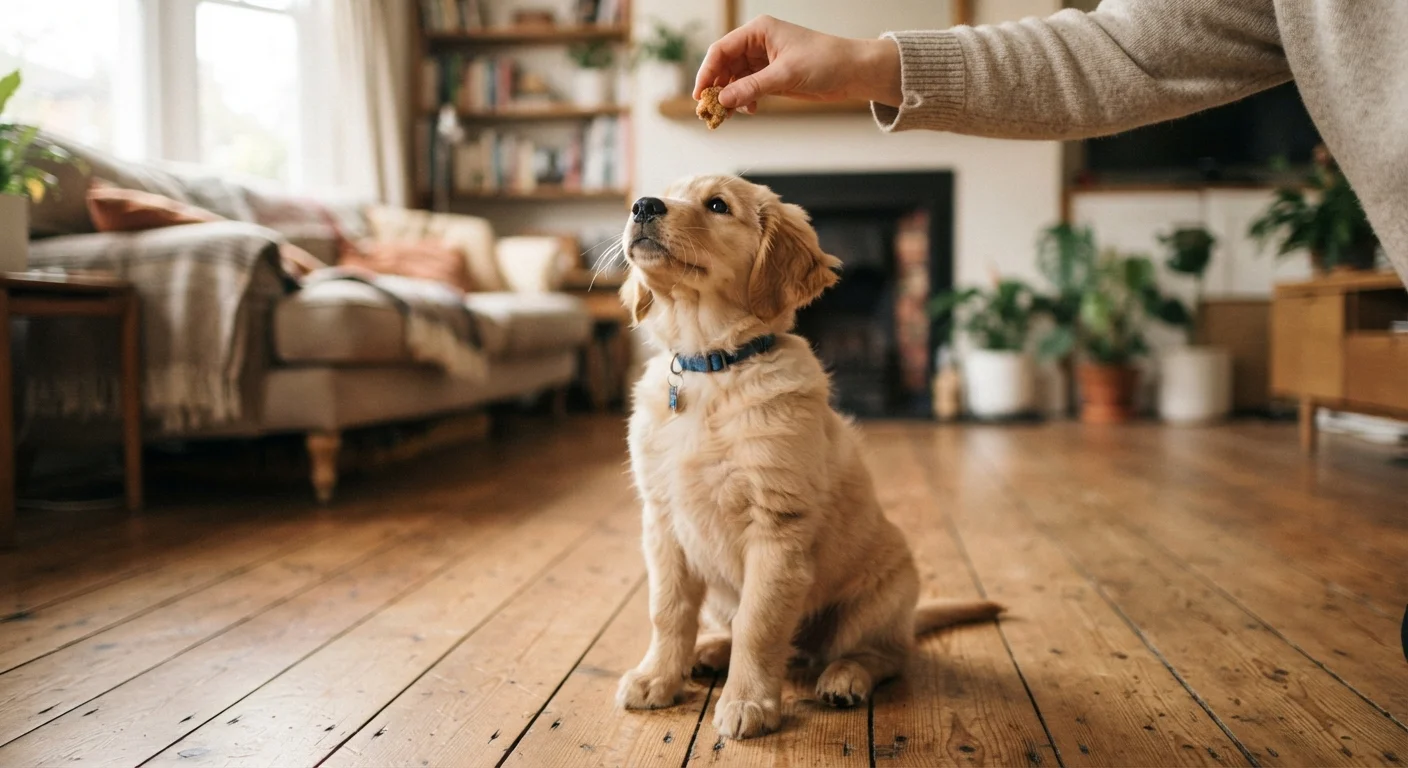
Positive reinforcement means that immediately after a behavior occurs, something the puppy values is added. That value causes the behavior to become more likely in the future. The reward does not have to be food, though food is the most practical tool for new learners because it is quick to deliver and highly motivating for most puppies.
A few things trip people up here. First, reinforcement is defined by effect, not intent. If you give a puppy a treat and the behavior does not increase, the treat was not functioning as reinforcement for that puppy in that context. Pay attention to what the behavior does over the next few days. Second, ignoring an unwanted behavior is not the same as punishing it. Removing attention (not reacting to jumping, for example) can reduce a behavior over time, but it works slowly and only when attention was truly the reward driving the behavior.
Puppies in households with young children face an added complication: children are unpredictable reinforcement sources. A toddler who squeals and runs when jumped on may accidentally reward jumping far more powerfully than you realize. The guide for families with young children addresses how to coordinate this dynamic.
Practice your timing before adding the puppy
Drop a treat the moment a commercial plays on TV, or mark the exact frame when a ball bounces. Timing feels obvious in theory but tends to lag in practice. A few minutes of solo repetition makes a noticeable difference when you move to actual training sessions with your puppy.
Timing: the single variable owners underestimate most
A puppy's brain can link a behavior to a consequence only when the consequence arrives within roughly one to two seconds of the behavior. After that window, whatever the puppy is doing at the moment of the reward is what gets reinforced, not what happened three seconds ago.
This is why owners sometimes feel that treats 'do not work.' The treats are fine. The timing is off. Saying 'good boy' ten seconds after a sit and then reaching for a treat reinforces the standing-up-and-waiting, not the sit. Many trainers use a short marker signal (a specific word like 'yes,' delivered exactly when the behavior happens) to bridge the gap while the treat is retrieved. The marker must be trained first so the puppy has learned it predicts the reward. Once that association is solid, your timing becomes dramatically easier to get right.
Structured daily routines also reinforce learning between sessions. Predictable schedules reduce anxiety and give puppies repeated, low-pressure practice moments throughout the day. The article on daily routines that help dogs feel secure explains how structure and training support each other.
Consistency, environment, and realistic expectations
A behavior learned in the kitchen is not automatically a behavior the puppy can perform at the dog park. Generalization (the ability to perform a skill in new places, with new distractions, around new people) takes deliberate practice across varied settings. The standard pattern is: train in a low-distraction space first, add one layer of difficulty at a time, and expect some temporary regression when the context changes significantly.
Household consistency matters just as much. A puppy allowed on the sofa by one family member but scolded by another is not being disobedient. That puppy is responding logically to conflicting information. Before training begins, a brief household agreement on what is and is not allowed saves weeks of confusion for everyone involved.
Rescue dogs present a different picture because their history and decompression needs change the timeline considerably. If you are working with a dog from a shelter, the rescue dog socialization guide outlines what progress actually looks like in that context.
Keep sessions short (three to five minutes), end while the puppy is still engaged, and track behavior trends over days rather than individual sessions. Progress in puppy training is not linear, but when the foundations are solid, the harder skills build on them reliably.
This article is for general educational purposes only and is not a substitute for guidance from a qualified veterinarian or certified professional dog trainer. If your puppy shows signs of fear, aggression, or significant anxiety, consult a professional before continuing a home training program.