

Key Takeaways
- Lifestyle inflation happens when spending rises in step with income, leaving savings rates unchanged.
- Hedonic adaptation makes upgraded living standards feel normal quickly, which drives further spending.
- Automating savings before discretionary spending reaches your checking account is a practical counter-measure.
- A rising income with a flat savings rate can leave you more financially exposed than a lower income with consistent saving.
- Tracking the percentage of income saved, not just the dollar amount, is the clearest way to spot the pattern.
Lifestyle inflation
Lifestyle inflation is the tendency to increase spending whenever income rises, so that a larger paycheck produces little or no additional savings. Each raise, bonus, or career step gets absorbed by a higher standard of living rather than building a financial cushion. The result is that two people earning very different salaries can end up with equally thin safety nets.
Economists sometimes call this 'expenditure creep' or link it to 'hedonic adaptation,' the psychological process by which people quickly normalize new comforts and seek the next upgrade.
Why income growth does not automatically create wealth
A common assumption is that earning more money solves money problems. In practice, many households find that each income increase gets absorbed almost immediately, leaving their financial position no stronger than before. This is lifestyle inflation at work.
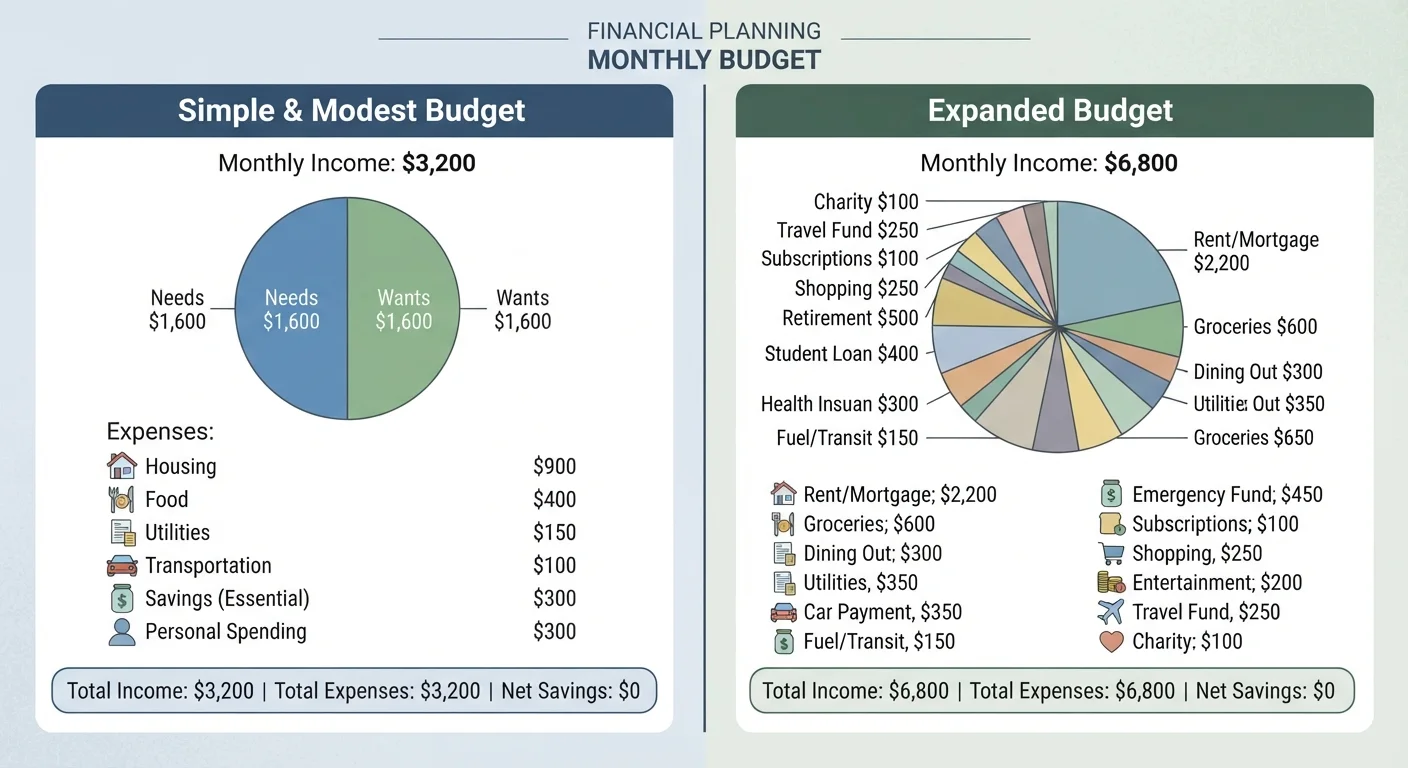
The pattern is straightforward: when income rises, expectations about normal spending rise with it. A person who lived comfortably on $50,000 a year receives a raise to $65,000 and, within months, has monthly expenses that require most of that new income to sustain. The raise felt significant, but the actual gain in financial security is close to zero.
This matters because the gap between income and spending is where savings live. If that gap stays constant in dollar terms but shrinks as a percentage of income, wealth accumulation slows, and any financial disruption (job loss, medical bill, car repair) hits harder than it should given the higher salary.
The psychology behind the pattern
Hedonic adaptation is the brain's tendency to treat new circumstances as the new baseline. A newer car, a larger apartment, or a regular restaurant habit stops feeling like an upgrade within weeks or months. Once normalized, giving it up feels like a loss rather than a neutral return to a prior state.
Social comparison adds pressure. When a salary increase moves someone into a different professional or social circle, spending norms in that circle shift upward too. Colleagues who drive newer cars, take more expensive vacations, or live in particular neighborhoods can make matching those choices feel expected rather than optional.
Neither force is unique to high earners. The psychological mechanics are the same whether the income change is a $200 monthly raise or a $2,000 one. What changes is the scale of the spending adjustment, not the tendency itself.
Check your savings rate, not just the dollar amount
When your income increases, calculate savings as a percentage of take-home pay rather than looking at the raw dollar total. A raise that pushes monthly savings from $300 to $350 looks like progress, but if income grew by 20% and savings grew by only 5%, the savings rate actually fell. The percentage is the more honest measure of whether you are getting ahead.
How to spot it in your own finances
The clearest signal is a flat or falling savings rate despite income growth. Most people track savings in dollar amounts, which can look better over time even when the percentage is shrinking. Recalculating savings as a share of take-home pay gives a more honest picture.
A second check is fixed monthly commitments. Subscriptions, lease payments, and recurring services are easy to add and hard to notice once they become automatic. Listing every recurring charge against what the same list looked like 12 or 24 months earlier often reveals several additions that were individually small but collectively significant.
Credit utilization patterns can also reflect the pattern. When ongoing expenses absorb most of a paycheck, credit tends to fill gaps more frequently, which can show up in utilization rates even when the balance feels manageable month to month.
Practical steps to redirect income growth
The most reliable counter-measure is to move money before discretionary spending has a chance to claim it. When a raise takes effect, increasing the automatic transfer to a savings or investment account by at least a portion of the net increase removes the decision from the monthly routine. Automating savings addresses the mechanics of setting this up without creating cash flow problems.
A second approach is to treat one-time income differently from recurring income. Bonuses, tax refunds, and side income are not built into a baseline budget, so directing them toward savings or debt paydown before they become available for spending avoids locking in a higher spending floor.
Understanding how money grows over time reinforces the case for acting early. Compound interest means that a dollar saved at 30 does more work than one saved at 40, so each year of lifestyle inflation that delays saving has a cost beyond the current year's balance.
This article is general financial education and does not constitute personalized financial advice. For guidance on savings rates, investment choices, or debt repayment strategy suited to your circumstances, consult a licensed financial professional.
This article is for informational purposes only and is not personalized financial, investment, or tax advice. Consult a qualified financial adviser before making decisions about your specific situation.