
Credit Utilisation and Your Savings Behaviour: The Connection Most People Miss

Key Takeaways
- High credit utilisation often signals the same cash-flow gap that prevents consistent saving.
- Reducing utilisation and building savings both require redirecting the same dollars.
- Your utilisation rate is reported monthly, so improvements can appear in your credit score relatively quickly.
- Automating savings transfers can lower utilisation indirectly by reducing reliance on credit for everyday spending.
- A written monthly budget is the common tool that addresses both problems at once.
Credit utilisation
Credit utilisation is the percentage of your total available revolving credit that you are currently using. If your credit cards have a combined limit of $10,000 and your current balances total $3,000, your utilisation rate is 30%. Lenders and credit bureaus treat this figure as a signal of how well you manage borrowed money.
Credit utilisation is calculated separately for each card and in aggregate across all revolving accounts. Most scoring models weight the aggregate figure most heavily, but a single maxed-out card can still drag down your score even when overall utilisation looks manageable.
Why these two metrics move together
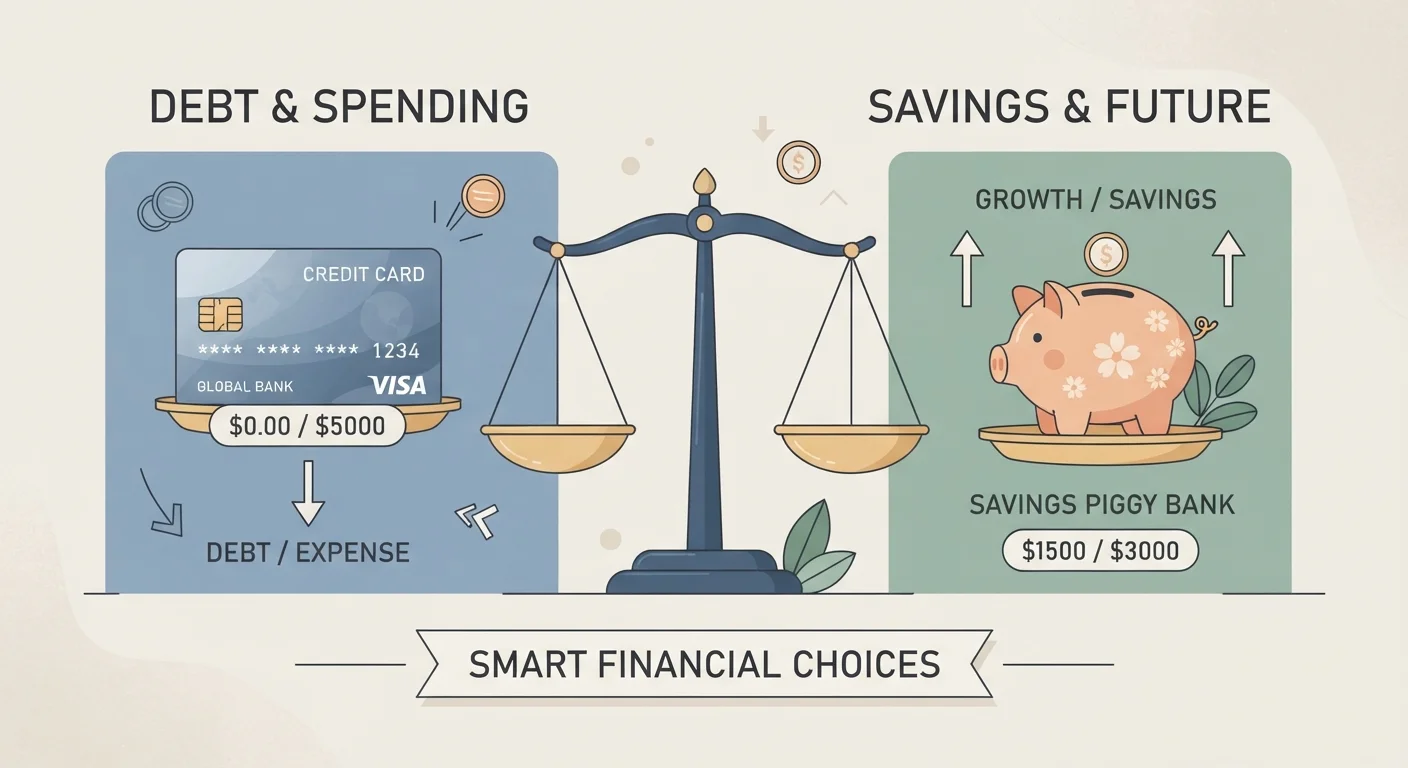
Credit utilisation and savings behaviour look like separate topics in most personal finance discussions. Credit utilisation lives in the credit score conversation; savings rates live in the wealth-building conversation. In practice, they respond to the same underlying condition: whether your monthly income reliably covers your monthly spending.
When spending routinely exceeds income, the gap gets filled one of two ways. Either you draw from savings, or you charge to a credit card. Both responses lower your financial cushion. The card balance shows up immediately in your utilisation rate; the savings shortfall shows up over time in a balance that never grows. Either way, the root cause is the same cash-flow problem.
This matters because fixing one without addressing the other rarely holds. Paying down a card balance while leaving the underlying spending gap in place means the balance climbs back up. Building savings while ignoring high-interest card debt means the interest charges quietly erode the amount you can actually save. The two are best treated as one problem with two visible symptoms.
Utilisation affects your score, not your credit history
Credit utilisation is a snapshot metric. Unlike a late payment, which stays on your credit report for up to seven years, a high utilisation rate can improve quickly once balances come down. This makes it one of the faster levers available when you are working to rebuild a credit score while also building savings.
How high utilisation becomes a savings barrier
Interest charges are the clearest mechanism. A card balance of $5,000 at an 22% annual percentage rate generates roughly $1,100 in interest over a year. That $1,100 cannot go into a savings account or an emergency fund. It goes to the card issuer. The higher the balance and the longer it stays, the more of your future income gets committed before you make a single discretionary choice.
There is also a credit-access effect. Borrowers with high utilisation often pay higher rates on new credit, because lenders treat utilisation as a risk signal. If a car loan or a personal emergency forces new borrowing at a higher rate, the monthly cost rises further, compressing the margin available for saving even more.
The patterns that contribute to high utilisation often run parallel to the habits that slow saving. Everyday financial habits that extend debt repayment, such as making minimum payments or not tracking card spending, also reduce the dollars available to save each month. Recognising the overlap is the first step toward addressing both.
The savings habits that lower utilisation over time
Building a cash reserve, even a modest one, directly reduces how often a credit card has to cover an unexpected cost. A car repair, a medical copay, or a broken appliance goes on the card when there is no buffer. With a buffer in place, the same expense leaves the bank account instead of raising the card balance. Utilisation stays flat; the savings account absorbs the shock and gets rebuilt.
Automating savings transfers on payday works the same way as automating a bill payment: the money moves before spending decisions get made. This is relevant to utilisation because it reduces the psychological temptation to treat available credit as available spending money. When a portion of each paycheck is already gone to savings, the card becomes a payment tool rather than a float mechanism.
Compound interest runs in both directions. On a savings account, it works in your favour. On a revolving card balance, it works against you. The gap between those two rates, the return on savings versus the cost of carrying card debt, makes it clear why reducing the balance typically comes before maximising the savings rate, though even small parallel contributions to savings help anchor the habit.
30%
Utilisation threshold widely cited in credit guidance
Most credit scoring guidance treats staying below 30% utilisation as a reasonable target, with the strongest scores typically associated with rates below 10%.
$1,100+
Annual interest on a $5,000 balance at 22% APR
At a 22% annual rate, a $5,000 card balance generates over $1,100 in interest charges per year, money that cannot be redirected to savings.
1 to 2
Billing cycles for utilisation changes to appear in score
Because card issuers report balances monthly, paying down a balance can affect your credit score within one to two billing cycles.
Using your monthly budget as the common tool
A budget that tracks income against all spending categories, including minimum debt payments and a savings contribution, makes the cash-flow gap visible. Without that visibility, both the credit card balance and the savings shortfall can persist without any obvious warning sign until the numbers become hard to manage.
A structured monthly budget review treats savings rate and debt balances as connected outputs of the same income-minus-expenses equation. When the budget shows that card spending is absorbing income that could go to savings, the decision about where to redirect dollars becomes concrete rather than abstract.
Lifestyle inflation, where spending rises in step with income, can mask this relationship. A household earning more than it did five years ago may have a higher card balance and a lower savings rate than expected precisely because spending grew in proportion to income. The budget makes that pattern visible by comparing categories over time, not just month to month.
This article is for informational purposes only and does not constitute financial advice. Consider consulting a licensed financial adviser for guidance tailored to your personal situation.