

Key Takeaways
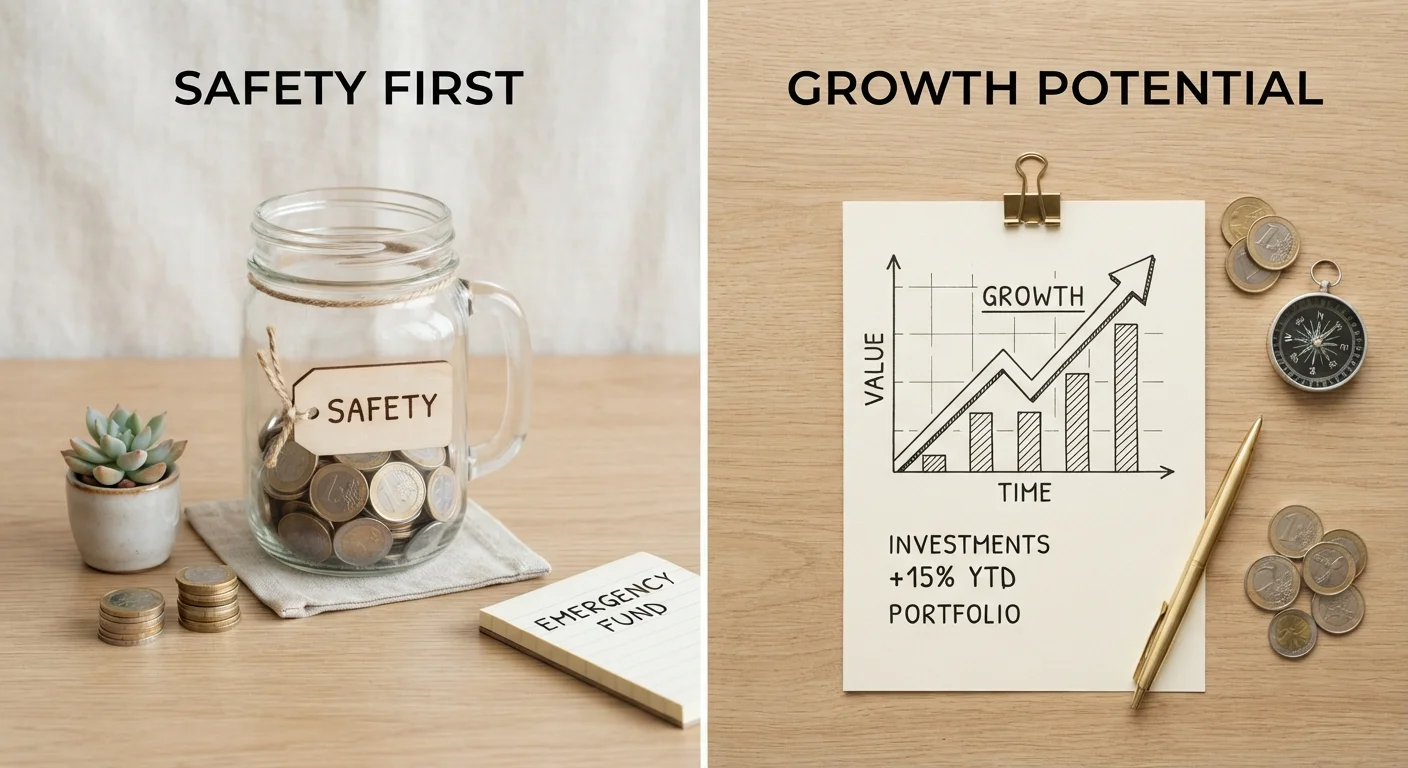
- Saving preserves money with minimal risk; investing grows money by accepting some risk.
- Inflation can erode the purchasing power of money left only in savings accounts.
- Investing is most effective over longer time horizons, where short-term volatility matters less.
- Both saving and investing serve distinct purposes and ideally work together in a financial plan.
- A licensed financial adviser can help match investment choices to your specific situation.
Investing
Investing means putting money to work in assets that have the potential to grow in value over time. Unlike saving, which typically keeps money in low-risk accounts with modest returns, investing accepts some level of risk in exchange for the possibility of greater long-term gains. Common investment vehicles include stocks, bonds, mutual funds, and real estate.
In financial terms, investing involves acquiring assets with the expectation of generating returns through price appreciation, dividends, or interest income, with returns not guaranteed and principal at risk.
Saving and investing are not the same thing
People often use the words interchangeably, but saving and investing describe two different financial behaviors with different purposes, different risk profiles, and different expected outcomes.
Saving means setting money aside in a secure account, usually a savings account or money market account, where the principal stays intact and earns a modest, predictable rate of interest. The goal is preservation: you want the money to be there when you need it, without the worry that it could drop in value.
Investing means putting money into assets, such as stocks, bonds, or funds, that carry some risk of loss but also the potential to grow significantly over time. The goal is growth: you accept uncertainty in exchange for the possibility of returns that outpace inflation and build long-term wealth.
Both belong in a sound financial plan. The question is not which one to choose, but how to use each one appropriately for its purpose. Understanding how saving and debt management relate gives useful context for where each fits.
Why saving alone is often not enough
A savings account feels safe because the balance does not drop. But inflation, the gradual rise in the price of goods and services, quietly reduces what that balance can actually buy over time. If a savings account earns 0.5% annual interest and inflation runs at 3%, your purchasing power shrinks each year even as the number in your account stays flat or grows slightly.
This is the core reason many financial educators encourage people to invest money they will not need for several years. Over long periods, investments in diversified assets have historically produced returns that exceed inflation, though past performance is not a guarantee of future results.
3% to 4%
Historical average annual US inflation rate
The US Bureau of Labor Statistics tracks the Consumer Price Index, which has averaged roughly 3% to 4% annually over long historical periods, illustrating the real cost of holding uninvested cash.
Over 10%
Average annual S&P 500 return (long historical periods)
The S&P 500 index has produced average annual returns above 10% over multi-decade periods historically, though returns vary significantly year to year and past performance does not guarantee future results.
Savings accounts are the right place for your emergency fund, a short-term goal, or money you expect to need within the next one to three years. Beyond that time horizon, leaving all discretionary money in cash may mean missing out on growth that could matter later in life.
To understand how interest compounds inside a savings account, this explanation of compound interest as a savings tool walks through the mechanics clearly.
How investing works in practice
When you invest, you buy an asset that has value and may generate returns in one of two ways: its price rises over time (capital appreciation), or it pays you income while you hold it, through dividends from stocks or interest from bonds.
Most individual investors access markets through pooled vehicles such as mutual funds or index funds, which hold many different assets within a single product. This spreads risk across many companies or sectors rather than concentrating it in one.
Time is a significant factor. Because markets fluctuate, a short holding period increases the chance that you need to sell during a downturn. Longer holding periods give investments more opportunity to recover from dips and grow. This is why financial guidance consistently links investing to goals that are at least five years away.
Two broad approaches to investing are worth knowing: growth investing versus income investing covers how each strategy works and what it is suited for. Passive investing is another approach that has become widespread and carries its own trade-offs.
Risk is a feature, not a flaw
One reason people hesitate to invest is that risk sounds like a problem to avoid. In financial terms, though, risk and return are linked. Assets with higher potential returns generally carry higher potential for loss. Assets with lower risk tend to offer lower returns.
Accepting a calibrated level of risk, matched to your time horizon and personal situation, is how investing works. A 30-year-old investing for retirement has a different risk profile than someone who needs funds in two years, and their investment choices should reflect that difference.
Common mistakes arise when people either avoid investing entirely out of fear, or take on more risk than their situation supports. A guide to common investing mistakes beginners make covers the patterns worth watching for before you start.
This article is for general informational and educational purposes only and does not constitute personalized financial, investment, tax, or legal advice. Consult a licensed financial adviser before making investment decisions.