
Growth Investing vs Income Investing: Two Different Goals, Two Different Paths

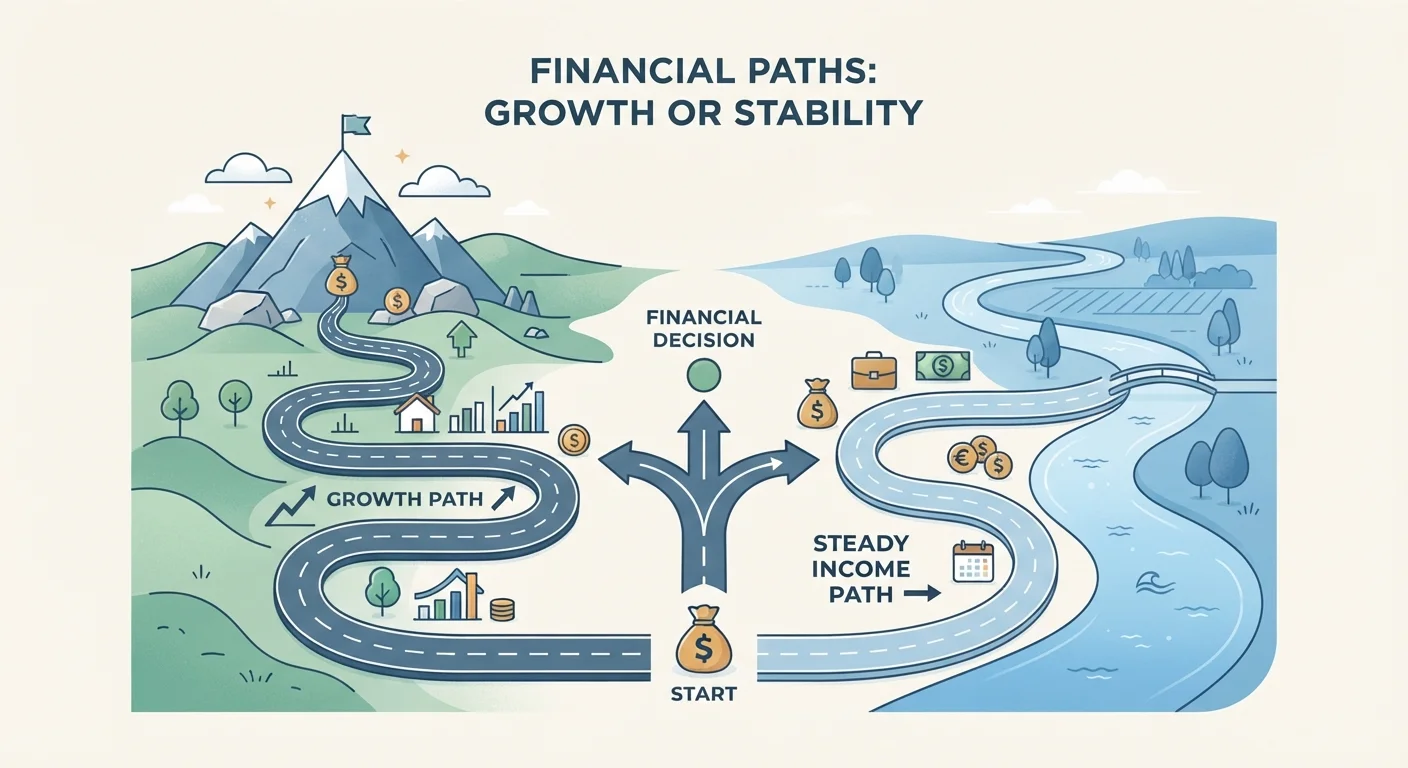
Key Takeaways
- Growth investing targets capital appreciation; income investing targets regular cash distributions.
- Growth investors typically reinvest gains rather than withdraw them, letting compounding do the work over many years.
- Income investors rely on dividends, interest payments, or rental income to cover ongoing expenses.
- Neither strategy is universally better; the right choice depends on your time horizon and financial goals.
- Many investors blend both approaches as their needs change throughout life.
- Tax treatment of capital gains and investment income differs, so account structure matters for both strategies.
Option A
Growth investing
The long-horizon approach focused on building wealth over time.
Best for: Investors with a longer time horizon who want their portfolio to compound in value and do not need regular cash payouts.
Option B
Income investing
The cash-flow approach designed to generate regular payouts.
Best for: Investors who need or want a predictable stream of money from their portfolio, such as those in or near retirement.
If you are decades away from needing your money
Growth investing
A long time horizon lets compounding work on reinvested gains, and you can ride out the higher volatility that often accompanies growth-oriented assets.
If you need your portfolio to supplement your monthly income now
Income investing
Dividend-paying stocks, bonds, and similar instruments generate cash you can spend without selling assets, which suits retirees and those with near-term cash needs.
If you want to build wealth first and shift to income later
Growth investing
Accumulating a larger portfolio base during working years gives you more assets to convert into income-generating holdings when the time comes.
If capital preservation matters more than maximum return
Income investing
High-quality bonds and dividend stocks tend to be less volatile than pure growth assets, which can reduce the emotional and financial strain of market downturns.
What each strategy actually means
Growth investing centers on buying assets expected to increase in value over time. The investor's return comes mainly from selling those assets at a higher price than they paid, a gain called capital appreciation. Stocks in companies that reinvest profits into expanding operations rather than paying dividends are a common example. The investor does not receive cash along the way; the reward is a larger portfolio balance.
Income investing centers on assets that pay out cash regularly. Dividends from stocks, interest from bonds, and distributions from real estate investment trusts are typical sources. The investor's goal is a reliable, recurring payment, not necessarily a rising asset price. Capital preservation, keeping the original sum intact, often matters as much as any price gain.
Both strategies involve owning assets and accepting risk. The difference is in what you want your portfolio to do for you right now versus later. Time horizon shapes this choice fundamentally: a 30-year-old saving for retirement faces a very different set of priorities than a 65-year-old who needs monthly income.
How each strategy works in practice
A growth investor typically holds assets for years or decades, reinvesting any proceeds rather than withdrawing them. The logic is that leaving gains in the portfolio lets compounding accelerate total value. Volatility is a normal feature of this approach: growth-oriented assets can lose significant value in a downturn, which is tolerable when the investor has time to wait for recovery. Staying invested through downturns rather than selling at a loss is central to how growth investing produces results.
An income investor builds a portfolio where the cash flow itself is the product. A retired person might hold a mix of dividend-paying stocks and bonds structured so that quarterly or monthly payments cover living costs. Reinvestment is optional: the payouts can be spent directly. This investor pays close attention to yield (the annual payout divided by the asset's price) and to the sustainability of that yield over time, since a company or government that cuts its payments reduces the investor's income without any selling required.
| Criterion | Growth investing | Income investing |
|---|---|---|
| Primary goal | Capital appreciation over time | Regular cash distributions |
| Typical assets | Growth stocks, growth-focused funds | Dividend stocks, bonds, REITs |
| When you benefit | When you sell at a higher price | Continuously via payouts |
| Volatility tolerance needed | Higher: prices can swing sharply | Lower: income more predictable |
| Reinvestment approach | Gains typically reinvested | Payouts can be spent directly |
| Best time horizon | Long (10+ years generally) | Flexible, including near-term needs |
| Main risk | Selling during a downturn | Yield cuts, inflation eroding income |
Tax treatment is worth noting here. In the US, qualified dividends and long-term capital gains are generally taxed at lower rates than ordinary income, though the specifics depend on the investor's total taxable income and account type. Holding income-producing assets inside a tax-advantaged account can reduce the drag that taxes impose on compounding. Always verify current rules with a licensed tax professional, since rates and thresholds can change.
The risks each approach carries
Growth investing accepts price volatility as the cost of pursuing higher long-term returns. A growth-focused portfolio can fall 30 percent or more in a market downturn and still fulfill its purpose if the investor holds on. The real risk is selling during a drop and locking in a loss, or needing the money before the portfolio has had time to recover. Reacting to short-term market swings is one of the most common and costly errors new investors make.
Income investing carries different risks. Yield can be cut without warning if a company's finances deteriorate. Rising interest rates tend to push bond prices down, reducing the market value of a bond-heavy income portfolio even when the income payments continue. Inflation is a particular concern: a fixed payment worth $1,000 today buys less in ten years if costs rise faster than the income does. Investors seeking stable income still need some exposure to assets whose payouts can grow over time.
A note on account structure
Where you hold your investments can matter as much as what you hold. Income-producing assets generate taxable events each year, which can reduce returns if held in a standard taxable brokerage account. Growth assets that you do not sell produce no taxable income until you sell, making them more tax-efficient in taxable accounts. Placing income-producing assets inside tax-advantaged accounts, such as a traditional or Roth IRA, is a common way to manage this. Speak with a tax professional to understand how these considerations apply to your situation, since rules vary and change over time.
Passive investing strategies can be applied to both growth and income goals through index funds that track growth-oriented or dividend-focused benchmarks, which can reduce costs compared to actively managed alternatives.
Combining both approaches
Most financial planning does not treat growth and income as a permanent binary choice. A common pattern is to pursue growth during working years, building up a portfolio, then gradually shift toward income-producing assets as retirement approaches. This is sometimes called a glide path: the portfolio's composition moves over time to match the investor's changing needs.
Some assets blur the line between the two strategies. Dividend-growth stocks, for example, pay a current income but also tend to appreciate in price over time, giving investors a partial benefit of both approaches. Real estate investment trusts provide income through distributions and can also gain value as property prices rise.
If you are weighing how these strategies fit your situation, it helps to start with two concrete questions: when will you need to use this money, and how much volatility can you tolerate without making panic-driven decisions? Talking through those questions with a licensed financial adviser can translate general principles into a plan suited to your specific circumstances. This article is general financial education and does not constitute personalised investment advice.
This article is for general informational purposes only and does not constitute personalised financial, investment, tax, or legal advice. Consult a qualified financial adviser or tax professional before making decisions about your own investments or financial situation.