

Key Takeaways
- Lump sum investing puts all available capital to work immediately, which historically outperforms gradual contributions in rising markets.
- Drip-feeding (dollar-cost averaging) spreads investment over time, reducing the risk of buying entirely at a market peak.
- Your choice should reflect your cash position, risk tolerance, and whether the money is already available or will arrive incrementally.
- Neither approach guarantees a better outcome; market conditions, investor behavior, and time horizon all matter.
- Consulting a licensed financial adviser before making large investment decisions is strongly recommended.
Our Verdict
Lump sum investing tends to produce stronger average returns when capital is available and the investor can tolerate short-term volatility. Drip-feeding is a practical fit when money arrives gradually or when market anxiety would otherwise push someone to stay out of markets entirely. The right approach is the one you can stick with consistently.
| Best for | Recommended |
|---|---|
| Those with a large amount already saved and a long time horizon | Lump sum investing |
| Those receiving income in regular installments or building a new habit | Drip-feeding (dollar-cost averaging) |
| Those highly anxious about investing at the wrong moment | Drip-feeding (dollar-cost averaging) |
| Those in or near retirement with a fixed inherited or liquidated sum | A hybrid approach discussed with a licensed financial adviser |
How each approach works
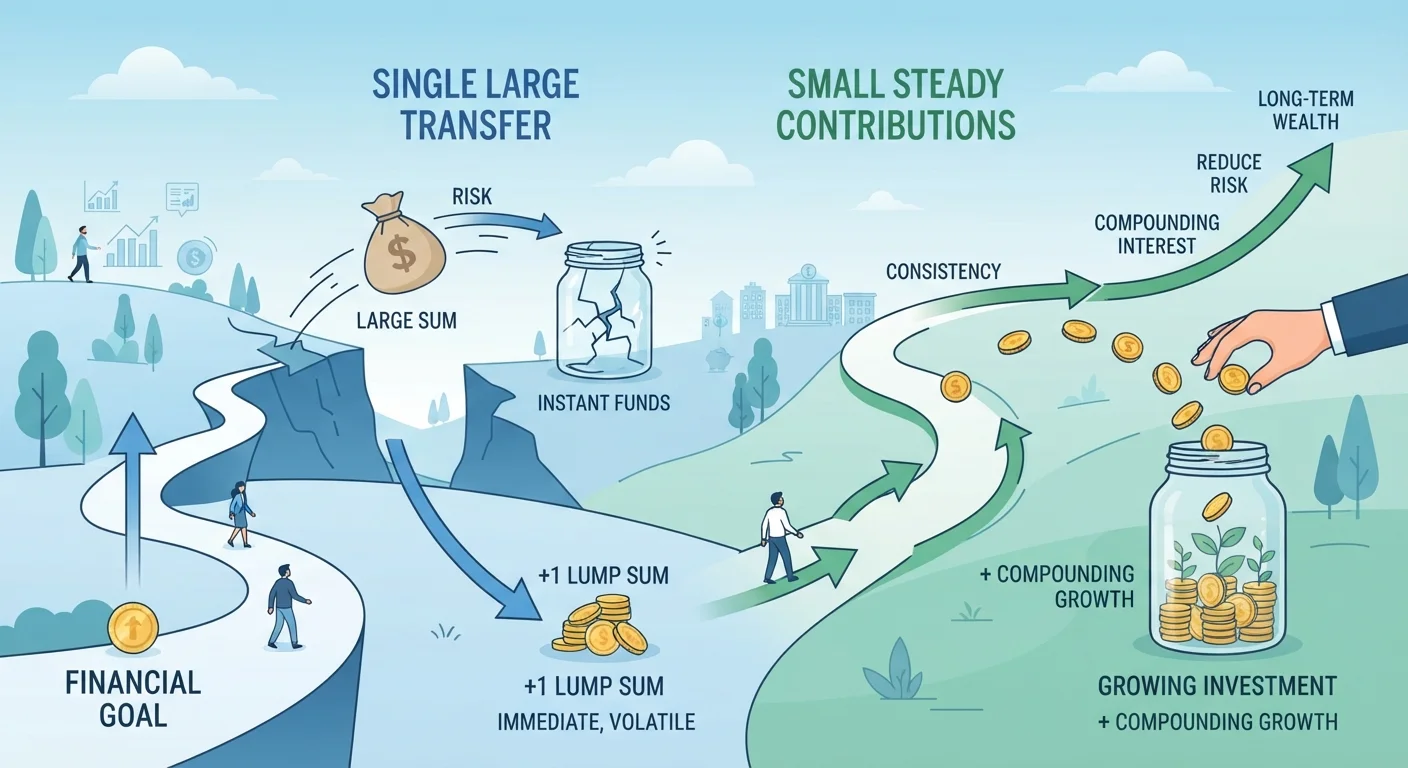
Lump sum investing means deploying all available capital into the market at one point in time. If you receive an inheritance, a bonus, or proceeds from a property sale, you invest the entire amount immediately rather than holding cash and waiting.
Drip-feeding, formally called dollar-cost averaging, means dividing that same total and investing fixed amounts at regular intervals over weeks or months. Each installment buys whatever quantity of shares or fund units the market price allows at that moment. For a full explanation of the mechanics, see how dollar-cost averaging works.
Both methods end with the same destination: your capital in the market. The difference is the path, the timing of each purchase, and the psychological experience along the way.
What the evidence suggests about returns
Research on this question consistently points in one direction. Because markets rise more often than they fall over long periods, money invested earlier has more time to compound. A 2012 Vanguard analysis found that lump sum investing outperformed a 12-month drip-feeding schedule in roughly two-thirds of historical rolling periods across US, UK, and Australian markets.
The logic follows from time in the market versus timing the market: cash sitting on the sidelines earns less than a diversified portfolio in most environments. Every month a portion of your capital waits, it misses any gains that occur during that interval.
That said, the one-third of periods where drip-feeding won were not random. They clustered around market peaks followed by sharp downturns. An investor who deployed a lump sum just before a major correction faced a long wait before recovering, while one who spread contributions bought at progressively lower prices during the downturn.
~68%
Periods where lump sum beat drip-feeding
A Vanguard analysis published in 2012 found lump sum investing outperformed a 12-month dollar-cost averaging schedule in approximately two-thirds of historical rolling periods across three major markets.
10+ years
Time horizon where lump sum advantage grows
The longer the investment period, the more the early-entry compounding advantage of lump sum investing tends to widen relative to a phased approach.
The case for drip-feeding beyond the numbers
Pure return comparisons assume the investor behaves identically in both scenarios. In practice, that assumption breaks down. An investor who watches a lump sum drop 20% in the first two months may panic and sell, locking in a real loss. The same investor using drip-feeding might stay the course because each new contribution feels manageable.
Behavioral consistency matters more than the theoretical edge of one strategy. Building the investing habit early through regular, automatic contributions trains discipline that compounds over a lifetime, separate from any market return.
Drip-feeding also fits naturally when capital is not yet available in a single block. Most wage earners do not receive windfalls; they accumulate savings month by month. For them, drip-feeding is not a strategy choice so much as a practical description of their situation. Automating those contributions removes the willpower requirement entirely.
A simple middle path for anxious investors
If a full lump sum feels too risky but you want more market exposure than a 12-month drip produces, consider a compressed schedule of three to six months. This limits the drag from cash sitting uninvested while still softening the impact of a sharp early decline. Run the plan by a licensed financial adviser to make sure it fits your specific situation and goals.
Comparing the two approaches directly
The table below summarizes the main trade-offs across several dimensions that matter to most investors.
| Lump sum investing | Drip-feeding (DCA) | |
|---|---|---|
| Market exposure | Immediate and full | Gradual, builds over time |
| Historical average return advantage | Outperforms in roughly 2/3 of periods | Outperforms after market peaks |
| Volatility risk at entry | Higher (full capital at risk immediately) | Lower (only partial capital exposed early) |
| Behavioral difficulty | High (requires accepting short-term swings) | Lower (smaller, regular amounts feel manageable) |
| Best capital situation | Large sum already available | Income arrives incrementally |
| Transaction costs | One transaction | Multiple transactions, potentially higher fees |
| Suitable time horizon | Long (10+ years ideally) | Flexible, suits any horizon |
Note that "market exposure" and "psychological comfort" often pull in opposite directions. Investors who want maximum exposure accept more short-term risk; those who want comfort accept a probable reduction in long-run returns.
Factors that should guide your decision
Before choosing, consider the following questions honestly.
- Is the money already available, or does it arrive in regular installments? If it arrives gradually, drip-feeding is the natural approach. If it is already sitting in cash, holding it out of the market is itself a decision with a cost.
- How would you respond to a 25% portfolio decline in the first year? If the honest answer is "I would probably sell," a phased entry reduces that risk.
- What is your time horizon? Over 20 or more years, short-term volatility smooths out and the compounding advantage of earlier investment grows. Over five years or fewer, sequence risk matters more.
- What are the transaction costs? Some brokerage accounts charge per trade. Multiple small purchases cost more in fees than one large one, which can erode the diversification benefit of drip-feeding.
For those with a significant sum to deploy, passive investing through index funds is one widely discussed vehicle that suits both strategies, since broad diversification reduces single-stock risk regardless of when you buy.
Your investment goals also shape the choice. Growth-oriented investors generally want maximum time in the market; income-focused investors may have different cash-flow considerations. And whichever method you choose, compound interest rewards the investor who starts sooner and stays consistent.
This article is for general informational and educational purposes only. It is not personalised financial or investment advice. Past performance does not guarantee future results. Consult a licensed financial adviser before making investment decisions based on your individual circumstances.