

Key Takeaways
- The title is the legal proof of vehicle ownership; without a clean transfer, the buyer does not truly own the car.
- A bill of sale records the sale terms and protects both parties if a dispute arises later.
- Odometer disclosure is federally required for most vehicles under ten years old.
- A lien on the title means a lender has a claim on the vehicle; that lien must be released before ownership can transfer cleanly.
- Missing or incorrectly completed paperwork can delay registration, trigger tax problems, or expose the seller to liability for future incidents.
Title transfer and bill of sale
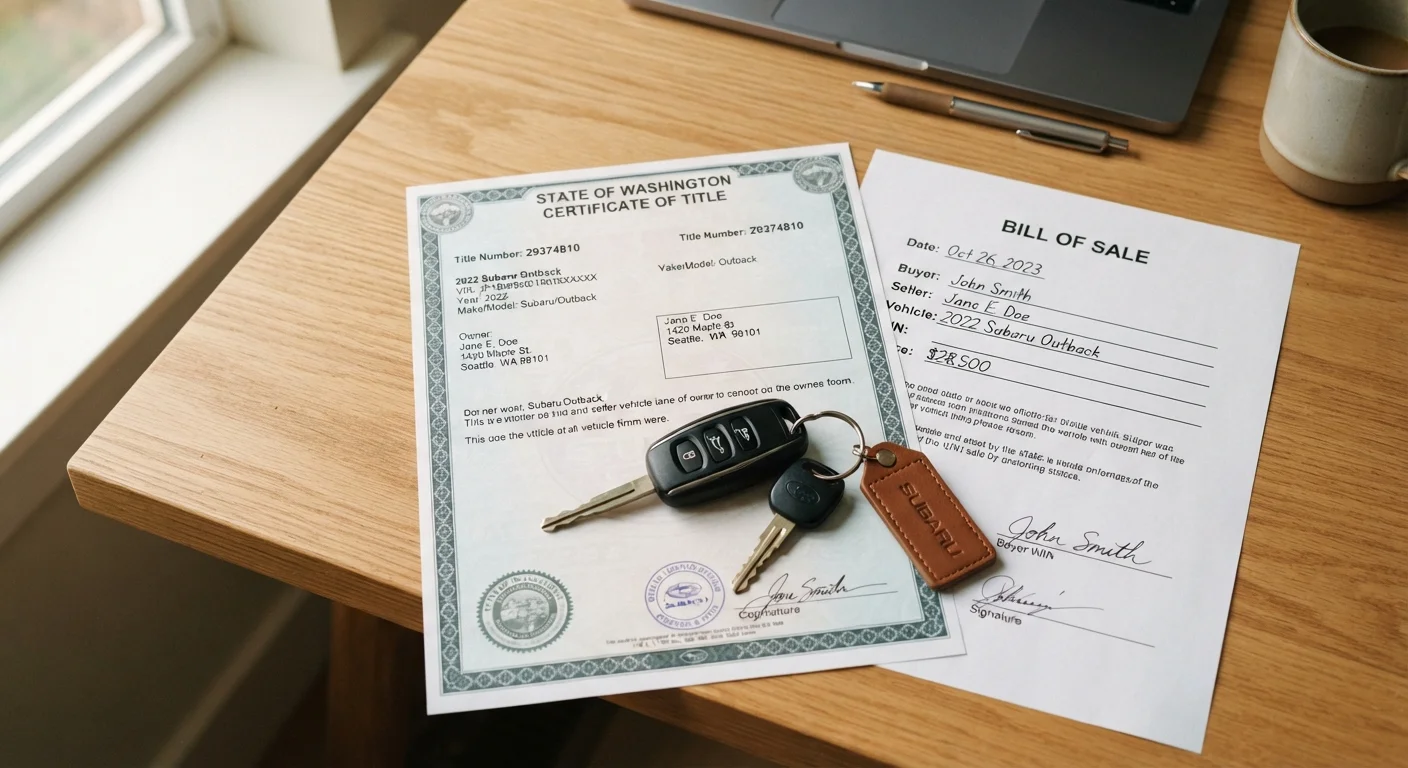
A title transfer is the legal process of moving ownership of a vehicle from one person to another through the state motor vehicle authority. A bill of sale is a written record of the transaction itself, documenting the agreed price, the parties involved, and the date. Together, these two documents complete the legal and financial record of a car sale.
Title certificates are state-issued instruments governed by each state's DMV or equivalent agency. Requirements for notarization, odometer disclosure, and filing fees vary by state.
Why paperwork determines who actually owns the car
A handshake and a cash payment feel like a done deal, but in the eyes of state law, a vehicle sale is incomplete until the title changes hands properly. The title is a state-issued certificate that names the legal owner. When a seller signs the back of the title and a buyer submits it to the DMV, ownership officially moves. Without that step, the seller remains the legal owner even if the buyer is driving the car.
This matters for more than legal formality. Insurance, registration, and tax records all follow the title. A buyer without a properly transferred title cannot register the vehicle, and a seller who skips the filing step may remain liable for parking tickets, tolls, or accidents that occur after the sale. Many states let sellers file a Notice of Transfer or Release of Liability to cut that exposure, but the requirement and the process differ by state.
For a complete picture of how ownership paperwork fits into the broader transaction, the full vehicle transaction walkthrough covers every stage from listing to title transfer.
What the title must show to be valid
A vehicle title contains several fields, and errors on any of them can stall or void the transfer. The seller must sign exactly as their name appears on the front of the title. A middle initial present on the title must appear in the signature; a misspelled name must be corrected through the DMV before the sale, not by crossing out and rewriting on the document.
Other required fields typically include:
- The buyer's full legal name and address
- The sale price (used by the state to calculate sales or use tax)
- The odometer reading at the time of sale
- The date of sale
Federal law under the Truth in Mileage Act requires an odometer disclosure statement for most vehicles less than ten model years old and with a gross vehicle weight rating under 16,000 pounds. Many states print the disclosure directly on the title; others use a separate form. Falsifying the odometer reading is a federal crime.
Complete every field before anyone leaves
Blank fields on a title are one of the most common causes of transfer delays at the DMV. Fill in every line, including the sale price and odometer reading, while buyer and seller are still together. Correcting an incomplete title after the fact can require tracking down the other party for an additional signature.
If the title has a lienholder listed, the lender's name appears on the front. That lien must be paid off and a lien release obtained before the title can be signed over. The process for selling a car with an active loan involves extra coordination with the lender, but it is manageable with the right steps.
What a bill of sale covers and why it matters
A bill of sale is not a government form in most states; it is a private written agreement between buyer and seller. Its core function is to record the terms of the transaction so both parties have a reference point if questions come up later.
A well-written bill of sale generally includes:
- Full legal names and contact information of both parties
- Vehicle identification number (VIN)
- Year, make, model, and color
- Odometer reading at the time of sale
- Agreed sale price
- Payment method
- An "as-is" clause if the vehicle is sold without warranty
- Signatures of both buyer and seller, with date
Some states do require a bill of sale or use it as the basis for calculating sales tax when no price appears on the title. Even where optional, the document protects the seller if the buyer later claims a different price was agreed, and it protects the buyer if the seller disputes the sale occurred at all.
If you are preparing to list your vehicle, the car preparation checklist covers gathering these documents before the first inquiry arrives.
Common problems and how to avoid them
Most title transfer problems come from a small set of recurring mistakes. A seller who signs with a nickname, leaves a field blank, or hands over a title with a correction fluid error will create a document the DMV may reject. The buyer then has to return to the seller for a corrected signature, which is inconvenient and sometimes impossible if the seller is no longer reachable.
Buying from a private party involves different considerations than a dealership transaction. Dealerships handle title paperwork as part of their standard process, while private sellers may not be familiar with what is required. The comparison of private sales and dealership trade-ins covers how the two differ in convenience and process.
A few practices reduce the risk of paperwork errors:
- Verify the title is in the seller's name before the sale date, not just at signing.
- Check that the VIN on the title matches the VIN plate on the dashboard and the door jamb.
- Complete all fields at the time of the transaction, not after the buyer has left.
- Both parties should keep a copy of the signed bill of sale.
This article provides general information about vehicle transaction documents and is not legal advice. Title transfer requirements vary by state. Consult your state's DMV or a qualified professional for guidance specific to your situation.