

Key Takeaways
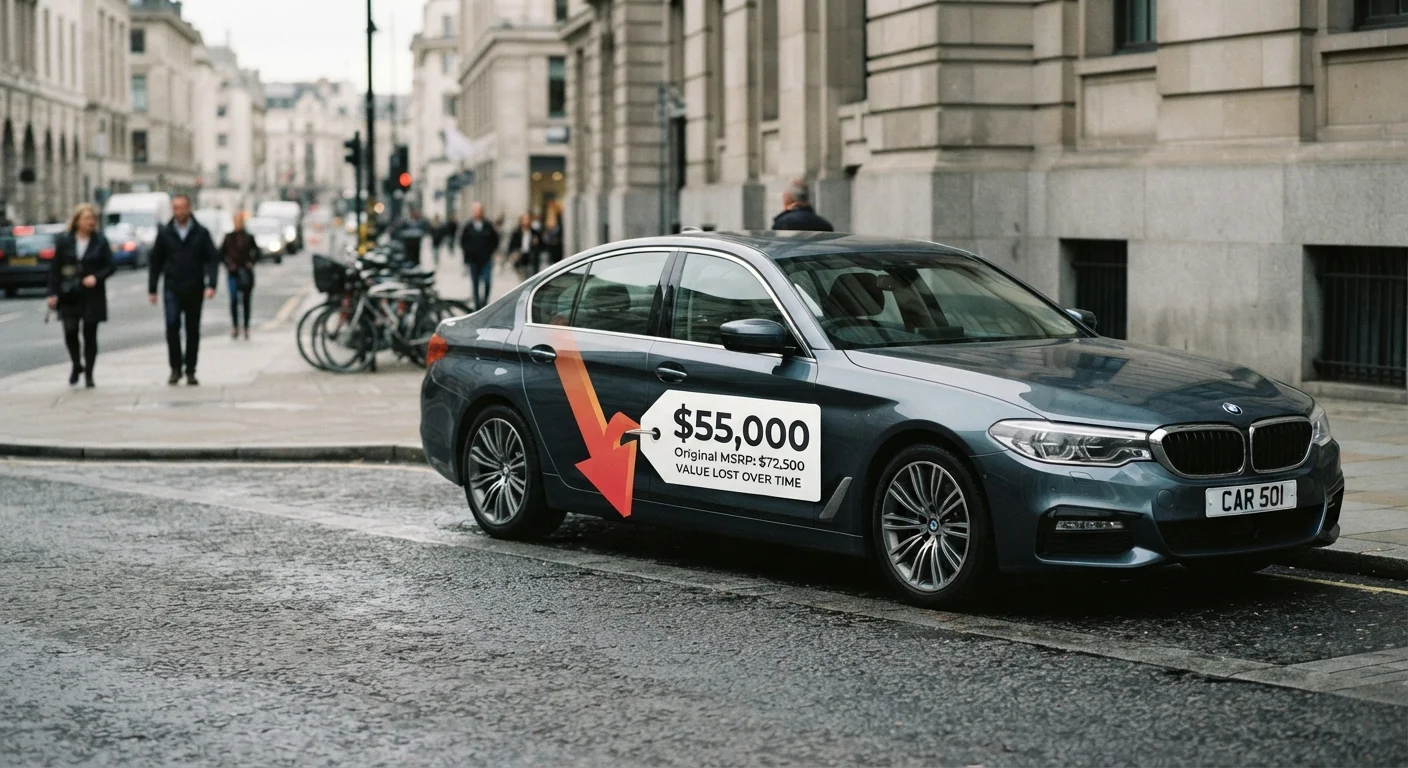
- New vehicles lose roughly 15 to 25 percent of their value in the first year alone.
- By year five, most vehicles have lost 40 to 60 percent of their original purchase price.
- Insurance payouts after a total loss are based on current market value, not what you paid.
- A gap between your loan balance and the car's ACV is called negative equity, and it can leave you financially exposed.
- GAP insurance covers the difference between an ACV payout and the remaining loan balance.
- Adjusting coverage as a vehicle ages can keep insurance costs proportional to the car's actual worth.
Car depreciation
Car depreciation is the decline in a vehicle's market value over time. It begins as soon as a car is purchased and continues throughout its life, though the rate slows considerably after the first few years. Depreciation affects what an insurer will pay after a total loss, how much equity you hold relative to your loan balance, and the true cost of owning a vehicle.
Insurers typically calculate a totaled vehicle's payout using Actual Cash Value (ACV), which is replacement cost minus depreciation. This figure can differ substantially from what the owner paid or what they still owe.
How the depreciation curve works
Depreciation is not linear. A vehicle loses value fastest early in its life, then the rate flattens as the car ages. In the first year, most new vehicles shed 15 to 25 percent of their purchase price. By the end of year five, cumulative depreciation typically reaches 40 to 60 percent of the original price, depending on the make, model, and market conditions.
After about seven to ten years, many vehicles have lost the bulk of their depreciable value and the annual dollar drop becomes much smaller. The steep early curve is why the first owner absorbs the most cost, and why a lightly used two- or three-year-old vehicle can represent better dollar-for-dollar value than a brand-new one.
Several factors affect how fast a specific vehicle depreciates: fuel economy, reliability ratings, brand perception, trim level, color, and the balance of supply and demand in the used-car market. Vehicles with strong resale reputations, such as full-size pickup trucks and certain compact SUVs, historically hold value better than the average passenger car, though no category is immune.
15-25%
Value lost in year one for most new vehicles
Automotive valuation sources including Edmunds and Kelley Blue Book consistently place first-year depreciation in this range for typical new cars.
~50%
Average value lost after five years of ownership
Industry valuation data suggests most mainstream vehicles retain roughly half their original value by the end of year five, though trucks and SUVs often fare better.
72 months
Common loan term that increases negative equity risk
Longer loan terms have grown more common in the U.S. market; with slower principal paydown, depreciation outpaces payoff in the early years, widening the gap between ACV and loan balance.
Depreciation and your insurance coverage
The connection between depreciation and insurance becomes concrete when a vehicle is declared a total loss. Most standard auto policies pay Actual Cash Value (ACV), which is the vehicle's market value at the time of the claim. That figure reflects depreciation, and it may be well below what you paid, what you owe, or what you feel the car is worth.
This is where the difference between ACV, agreed value, and stated value policies becomes financially meaningful. ACV is the standard, but agreed-value policies lock in a payout figure at the start of the policy. Agreed-value coverage is more common for classic or collector vehicles than for everyday cars.
For drivers financing a new or nearly new vehicle, a gap between the loan balance and the car's ACV is a real risk. If you owe $28,000 on a car the insurer values at $22,000 after a total loss, the $6,000 difference comes out of your pocket unless you carry GAP insurance. GAP coverage is worth evaluating whenever a down payment is small or a loan term is long, both of which increase the chance that depreciation outpaces payoff. See the annual vehicle ownership cost worksheet to factor GAP premiums alongside your other ownership costs.
Adjusting coverage as your vehicle ages
Comprehensive and collision coverage protect a vehicle's physical value. As that value falls, the math behind carrying those coverages changes. If a car's current market value is $4,000 and the annual cost of comprehensive and collision coverage is $600 with a $500 deductible, the maximum net benefit from a total-loss claim is $3,500. Whether that premium is still worthwhile depends on your ability to replace the vehicle without insurance help.
A widely cited rule of thumb is to reconsider comprehensive and collision coverage when their combined annual cost approaches 10 percent of the vehicle's market value. That figure is a starting point for a conversation, not a firm cutoff. Your financial cushion, driving environment, and risk tolerance all factor in. The guide to managing auto insurance costs over time covers the broader process of calibrating coverage to an aging vehicle.
Your deductible level also interacts with depreciation. As a car's value drops, a high deductible reduces the potential payout further. Review both the deductible and the coverage types together rather than in isolation.
This article is for general informational purposes only and does not constitute financial, insurance, or legal advice. Coverage terms, payout methods, and policy options vary by insurer and by state. Consult a licensed insurance agent or financial adviser for guidance specific to your situation.