

Key Takeaways
- ANC uses microphones to sample ambient sound, then produces an inverted wave to cancel it.
- The technology works best on low-frequency, steady noises rather than sudden or high-pitched sounds.
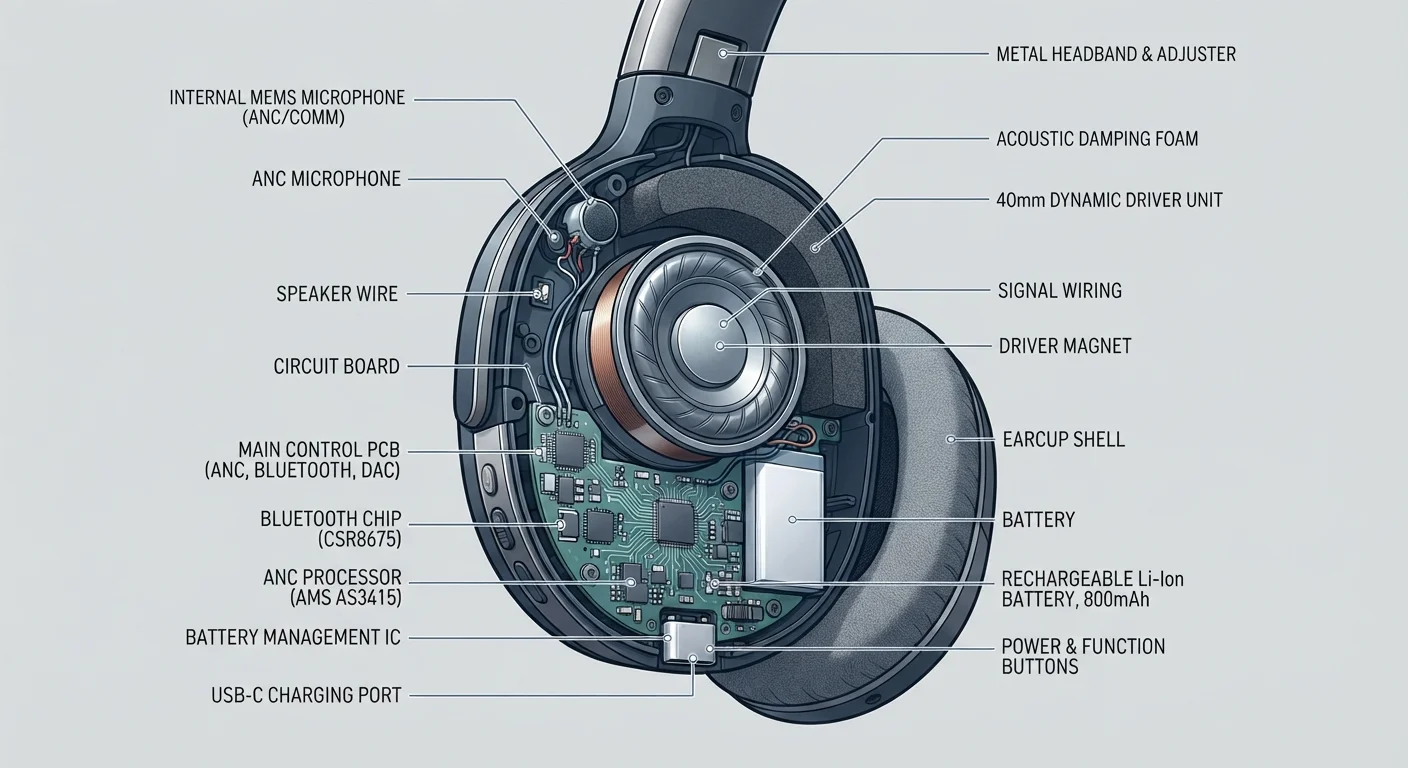
- Feedforward, feedback, and hybrid ANC each place microphones differently, affecting performance.
- ANC processing introduces a small audio delay, which manufacturers work to minimize.
- Passive isolation from earcup or eartip fit works alongside ANC, not instead of it.
Active noise cancellation
Active noise cancellation (ANC) is a technology that uses microphones and a small processor to detect incoming sound waves, then generates an opposing sound wave to cancel them out before they reach your ears. Unlike passive sound blocking, which relies on physical materials to muffle noise, ANC actively fights sound with sound. The result is a reduction in steady, repetitive background noise such as engine hum, air conditioning, or crowd rumble.
ANC works on the principle of destructive interference: two sound waves with equal amplitude and opposite phase combine to produce near-silence at the listener's ear canal.
The physics behind cancelling sound
Sound travels as waves: alternating zones of compressed and rarefied air that vibrate your eardrum. When two sound waves meet, they interact. If a crest from one wave aligns with a trough from another of equal strength, the two cancel each other out. This is called destructive interference.
ANC hardware exploits this property deliberately. A microphone records the ambient noise around you. A processor analyzes that sound and calculates what an exact mirror-image wave would look like: same frequency, same amplitude, but with the phase flipped 180 degrees. The headphone's speaker then plays that inverted signal in real time alongside your audio. When the inverted wave meets the original noise wave near your ear canal, they subtract from each other, and what you hear is substantially quieter.
The challenge is timing. Sound moves fast, and the processor must generate the cancelling signal quickly enough that it arrives at your ear at the same moment as the noise it is meant to cancel. Any delay, called latency, reduces accuracy. Modern ANC chips handle this in microseconds.
Where the microphones go and why it matters
ANC systems fall into three basic configurations based on microphone placement.
Feedforward ANC places the microphone on the outside of the earcup or earbud, facing away from your ear. It samples noise before the noise enters the ear cavity, giving the processor more time to react. This design handles a wider range of frequencies but is sensitive to wind noise because the external mic is exposed to air movement.
Feedback ANC places the microphone inside the earcup, close to your ear. It samples what you are actually hearing rather than what is approaching. This is more accurate but has less reaction time, because the noise has already partially arrived. It handles lower frequencies well and adapts better if the headphone shifts on your head.
Hybrid ANC uses both an external and an internal microphone simultaneously. The external mic provides early warning, and the internal mic corrects the output based on what is actually reaching your ear. Most high-performance devices now use a hybrid approach because it compensates for the weaknesses of either configuration alone.
Check which ANC type a device uses
Product specifications sometimes specify feedforward, feedback, or hybrid ANC, though not always. If the listing mentions multiple microphones per ear (typically three or more per side), that is a sign of a hybrid implementation. More microphones generally means better ambient sampling and more precise cancellation.
What ANC handles well and where it struggles
ANC performs best on predictable, low-frequency, continuous sounds. Airplane cabin pressure hum, the drone of an air conditioner, and train or bus engine noise are near-ideal targets because they are steady enough for the processor to model and cancel reliably.
It performs less well on high-pitched, sudden, or complex sounds. A dog barking, a car horn, or overlapping conversation shifts in frequency and amplitude too quickly for the cancelling wave to stay accurate. The processor generates its best approximation, but the result is a reduction rather than elimination.
Fit also matters. ANC cannot compensate for a poor physical seal. An earcup that sits loosely on the head or an eartip that does not seal the ear canal lets noise bypass both the ANC system and any passive material. The cancelling wave is generated inside a closed cavity; if that cavity is open, the physics do not work correctly.
20 Hz to 1 kHz
Frequency range ANC handles most effectively
This is the low-frequency band where engine hum, HVAC noise, and transportation rumble typically fall, which is why ANC is most effective in transit environments.
Under 1 ms
Target latency for ANC signal processing
ANC processors must generate and output the inverted signal within roughly one millisecond to achieve accurate cancellation before the ambient noise reaches the ear canal.
The role of passive isolation alongside ANC
Passive isolation is the sound blocking provided purely by materials: the density of the earcup padding, the depth of the ear canal seal, and the clamping force that holds the headphone against your head. It requires no power and works on all frequencies, including the high-frequency range where ANC is least effective.
In practice, ANC and passive isolation divide the work. Passive isolation handles higher frequencies (roughly above 1 kHz), while ANC targets the low-frequency range (roughly below 1 kHz) where passive materials are less effective. A well-designed device uses both together so the combined result is broader noise reduction across the audible spectrum than either approach achieves alone.
This is why the physical fit of a headphone or earbud is not a secondary concern. A poor seal weakens both systems at once. When evaluating how well a device reduces noise, fit is as consequential as the ANC hardware itself.
Transparency mode is ANC in reverse
Many ANC devices include a transparency or ambient mode. Instead of cancelling external sound, this mode amplifies the microphone feed so you can hear your surroundings without removing the headphones. It uses the same microphone and processing hardware, just with a different instruction to the signal processor. Switching between ANC and transparency mode does not change the hardware, only the software behavior.