

Key Takeaways
- Hiding is a normal biological response in cats, not a personality quirk or deliberate avoidance.
- Cats evolved to conceal weakness because showing vulnerability attracted predators in the wild.
- A sudden change in hiding pattern is one of the earliest and most reliable signs that something is wrong.
- Owners who know their cat's typical resting spots can detect unusual withdrawal faster.
- A vet visit is warranted whenever hiding accompanies changes in appetite, grooming, or litter box habits.
Illness concealment in cats
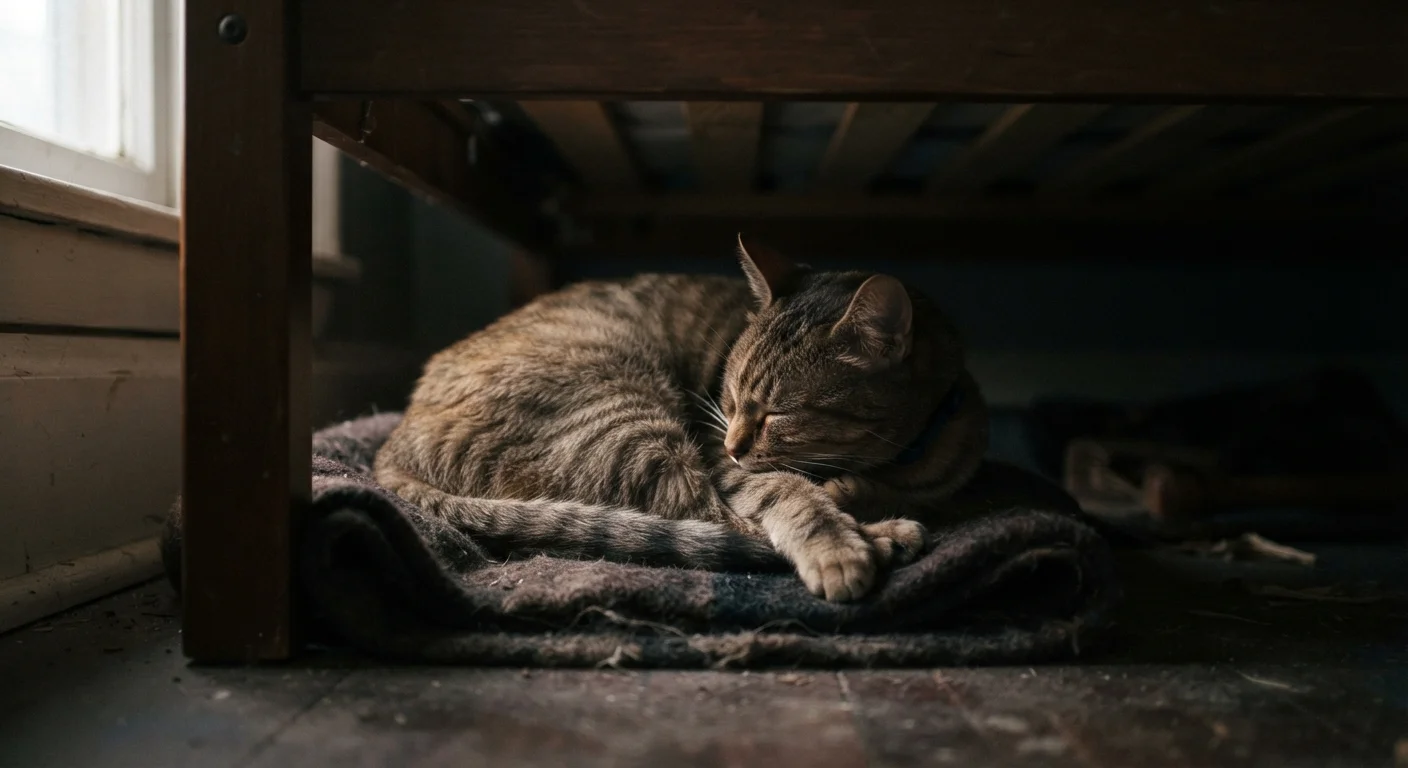
Illness concealment is the instinctive tendency of cats to hide physical weakness or discomfort from those around them. Rather than signalling distress openly, an unwell cat will often withdraw to a quiet, enclosed space and reduce all visible activity. This behaviour is rooted in survival biology, not stubbornness or a desire to be alone.
The behaviour is sometimes described in veterinary literature as 'masking,' where prey-driven social instincts suppress outward pain signals even when pathology is significant.
Why biology drives cats to hide weakness
Cats are what biologists call 'solitary hunters': they evolved without a pack to protect them when injured. An animal that displayed visible distress in the wild became an easier target. Over thousands of generations, cats that suppressed outward signs of weakness survived longer and passed that behaviour on. The result is a species wired to mask pain and illness even when doing so works against them in a domestic setting.
This is worth holding onto when you notice your cat retreating. The hiding is not passive or random. It is an active physiological and behavioural response, shaped by survival pressure long before cats shared our homes.
Domestic cats retain this instinct fully intact. Breeding for tameness changed coat colours and ear shapes far more readily than it changed deep survival wiring. So a cat that has lived indoors its whole life will still seek out a dark, enclosed space when it feels unwell, because that impulse does not require any real-world predator threat to be activated. The body's stress response triggers it automatically.
How vets assess pain in animals that cannot communicate it follows a similar logic: because cats suppress outward signs of distress, clinicians rely on subtle posture and behavioural cues rather than obvious signals.
What cats are actually doing when they hide
When a cat withdraws to a cramped, dark spot, several things happen at once. Reducing movement conserves energy the body needs for healing. Staying still minimises pain caused by movement. Darkness and enclosure reduce sensory stimulation, which can lower the physiological stress load.
These are adaptive responses. The problem for owners is that they look identical to ordinary catnapping, especially in cats that already enjoy quiet corners. This is why a sudden change in your cat's specific hiding patterns matters more than the act of hiding alone.
Map your cat's normal resting spots
Spend a few days noting where your cat typically sleeps and rests at different times of day. When you know the usual pattern, any departure becomes obvious quickly. This simple habit lets you catch unusual hiding far earlier than owners who have no baseline to compare against.
Cats also stop grooming certain areas when movement is painful. A normally well-kept cat that develops a matted patch, or that grooms one area obsessively, may be responding to discomfort in that location. Pair that observation with any hiding shift and you have a stronger case for a vet visit.
Signs of dehydration that owners often miss are also worth monitoring: a cat hiding and drinking less is a combination that can indicate systemic illness progressing faster than the hiding alone suggests.
Recognising the difference between normal rest and illness hiding
Most cats have a preferred circuit of resting spots. They cycle through those places predictably over a day. When illness hiding begins, the circuit changes. A cat that normally shifts between the sunny windowsill, the living room couch, and the end of a bed may suddenly spend an entire day in one spot under the bathroom sink, without eating.
The location shift is the signal. A cat choosing a new, more inaccessible spot, particularly one that is cooler, darker, or harder for other pets or people to reach, is behaving differently from its own normal. That difference is what owners should track.
Senior cats deserve extra attention here. Conditions like kidney disease, hyperthyroidism, and arthritis all have hiding as an early symptom, and those conditions are common in cats over ten years old. The health implications that differ between indoor and outdoor cats also shape which illnesses are more likely, because outdoor cats face different infection and injury risks.
When to contact your vet
Hiding alone is not automatically a medical emergency, but it warrants a vet call when it appears alongside any of these: going without food for more than 24 hours, skipping the litter box or producing unusually small amounts, vocalising when touched, breathing with visible effort, or any facial discharge.
If your cat is hiding and you cannot easily check on it, that itself is a sign to act. A cat that resists being gently approached or handled during a check is often in pain. Pain in cats, as veterinary assessments confirm, does not always look like obvious distress. It often looks like stillness. This article is for general informational purposes only and is not a substitute for professional veterinary advice. Always consult a licensed veterinarian if you are concerned about your cat's health.
This article is for informational purposes only and is not veterinary advice. If you are concerned about your cat's health, consult a licensed veterinarian promptly.