

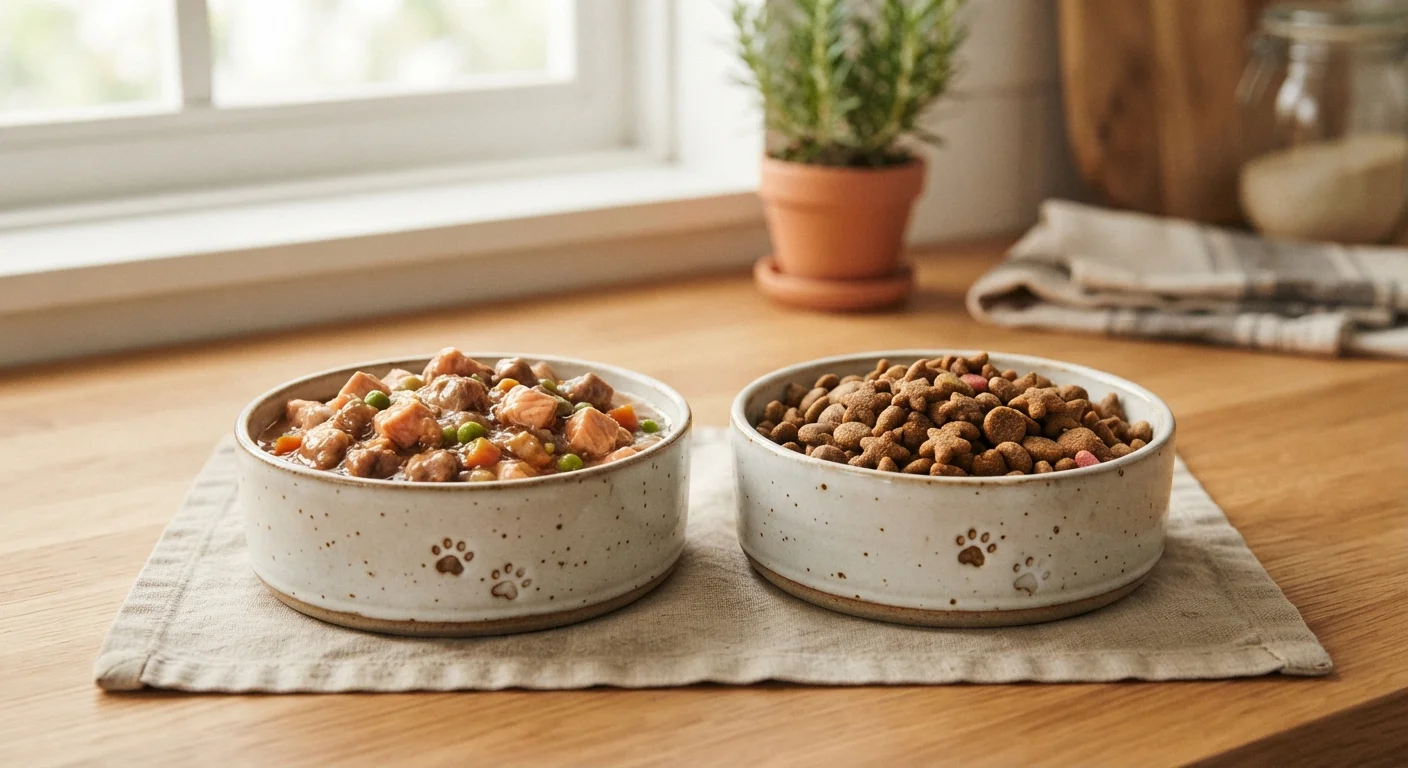
Key Takeaways
- Wet food contains 70 to 80 percent moisture, which supports urinary tract health in cats.
- Dry food is more calorie-dense per gram, making portion control especially important.
- Neither format is universally superior; a cat's health status shapes which suits them better.
- Dental health claims for dry food are more limited than commonly believed.
- Many veterinarians support mixing both formats to balance hydration and convenience.
Option A
Wet cat food
The high-moisture, protein-forward option
Best for: Cats who need extra hydration, seniors, or those with urinary or kidney concerns.
Option B
Dry cat food
The convenient, calorie-dense staple
Best for: Owners managing multi-cat households, free-feeding schedules, or tighter budgets.
If your cat has a history of urinary tract issues or kidney disease
Wet cat food
The high moisture content helps increase daily fluid intake, which supports kidney function and reduces the risk of crystal formation. Always confirm dietary changes with your veterinarian.
If you need a practical, budget-friendly daily feeding option
Dry cat food
Dry food costs less per calorie, stays fresh in the bowl longer, and works well for measured or timed feeding routines.
If your cat is overweight or prone to overeating
Wet cat food
Wet food's high water content adds volume per serving with fewer calories, which can help cats feel fuller without excess caloric intake.
If you have a multi-cat household with varied schedules
Dry cat food
Dry kibble does not spoil quickly at room temperature, making it practical when cats graze at different times throughout the day.
If you want to address both hydration and feeding flexibility
Wet cat food
A mixed feeding approach, using wet food as the primary source and dry food as a supplement, lets you capture the hydration benefit while retaining some convenience.
Why the format of cat food actually matters
Cats evolved as desert predators who got most of their water from prey, not from a separate water bowl. Their thirst drive is lower than dogs or humans, which means the food itself carries real hydration responsibility. That biological reality is what makes the wet versus dry question more than a preference: the format directly affects fluid intake, calorie load, and how the body processes nutrients.
Neither format is a shortcut to a poor diet. A high-quality dry food outperforms a low-quality wet food in many respects. But when two foods are nutritionally comparable, the moisture level alone can tip the balance for cats with specific health needs. Understanding the trade-offs lets you make a choice that fits your cat rather than following a blanket rule.
Hydration and urinary health
Wet food typically contains 70 to 80 percent moisture by weight. Dry food usually sits between 8 and 12 percent. A cat eating wet food as its primary diet consumes significantly more water per meal without needing to drink separately, which matters because chronic mild dehydration contributes to lower urinary tract disease and, over time, can stress the kidneys.
Cats prone to struvite or calcium oxalate crystals, or those already managing chronic kidney disease, often do better on wet food for this reason. Veterinarians frequently recommend increased moisture intake as a first-line dietary adjustment for these conditions. That said, wet food is not a treatment for diagnosed kidney disease; it is one tool within a broader care plan that your vet should guide.
If your cat drinks freely from a fountain or bowl and maintains good urinary health, dry food may not pose a hydration problem. Context matters more than the format alone. For more on how a cat's lifestyle intersects with health, see indoor versus outdoor health trade-offs for a broader look at environment and wellness.
| Criterion | Wet cat food | Dry cat food |
|---|---|---|
| Moisture content | 70 to 80 percent | 8 to 12 percent |
| Calories per serving | Low (high volume, fewer calories) | High (small volume, more calories) |
| Urinary health support | Strong (high fluid intake) | Limited without extra water intake |
| Dental health benefit | Minimal | Minimal (standard kibble) |
| Shelf life after opening | 1 to 2 days refrigerated | Weeks in airtight container |
| Cost per calorie | Higher | Lower |
| Satiety per serving | Higher (volume fills faster) | Lower (easy to overeat) |
Calories, protein, and weight management
Dry food is calorie-dense. A cup of dry kibble can contain 300 to 400 calories, while a 3-ounce can of wet food typically delivers 70 to 100 calories. This difference is almost entirely due to water. On a dry-matter basis (comparing nutrients after stripping out moisture), many wet and dry foods are nutritionally similar in protein and fat percentages.
The practical effect is that it is easy to overfeed a cat on dry food, especially with free-choice feeding. Cats often self-regulate with wet food better because the volume per calorie is much higher, producing a fuller feeling sooner. For cats managing obesity, switching to wet food or adding wet meals to reduce total calorie density is a common veterinary recommendation.
Protein quality matters more than format. Cats are obligate carnivores and need animal-sourced protein to obtain taurine and arachidonic acid, nutrients they cannot synthesize from plant sources. Check ingredient lists on both formats: named meat or fish as the first ingredient signals higher animal-protein content than grain or by-product fillers placed ahead of it.
70-80%
Moisture in wet cat food
Compared to roughly 10 percent in dry kibble, this difference substantially affects a cat's daily fluid intake.
~300-400 kcal
Calories per cup of dry kibble
A standard 3-ounce serving of wet food typically delivers 70 to 100 calories, making portion size comparison between formats non-intuitive.
1 in 3
Cats affected by dental disease by age 3
The American Veterinary Medical Association has noted that periodontal disease is among the most common health problems in domestic cats, regardless of diet format.
The dental health claim examined
A common argument for dry food is that crunching kibble cleans teeth. The evidence behind this is modest. Most cats bite kibble in half or swallow pieces whole rather than chewing long enough to produce meaningful mechanical cleaning. Some veterinary dental diets (a specific category, not standard kibble) are designed with larger, textured pieces intended to increase chewing time, and those do show measurable plaque reduction in controlled studies.
Standard dry kibble does not reliably prevent periodontal disease. Wet food does not accelerate it by default, though its stickier texture can leave residue if oral hygiene is ignored. For cats prone to dental disease, tooth brushing, water additives approved by the Veterinary Oral Health Council, or veterinary dental cleanings are more effective approaches than relying on either food format to do the work.
Practical and cost considerations
Dry food costs less per calorie in most US markets and stays stable in an airtight container for weeks. Wet food requires refrigeration after opening and should not sit in the bowl for more than a few hours at room temperature. For owners managing multiple cats, travel, or irregular schedules, dry food is genuinely easier.
A mixed approach works for many households: wet food in the morning and dry food available through the day, or wet food as the primary diet with a small dry portion for convenience. This is not a compromise so much as a practical way to capture the hydration benefit of wet food without abandoning the flexibility of dry. Whichever format you use, consistent meal amounts and scheduled feeding times help with weight monitoring and early detection of appetite changes, which are often the first sign a cat is unwell.
This article is for informational purposes only and does not constitute veterinary advice. Consult your veterinarian before making significant changes to your cat's diet, especially if your cat has an existing health condition.